Christian Worldview
31 Dec 2025
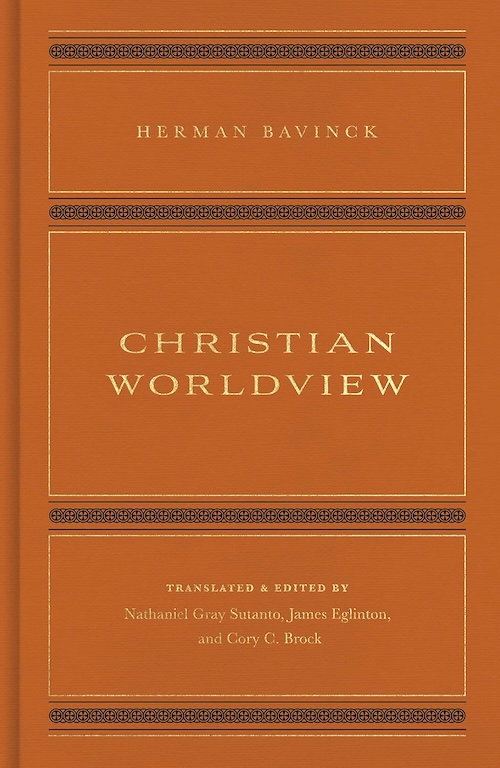
Christian Worldview
Herman Bavinck
Crossway, 2019
A dense, philosophical presentation and defense of the Christian worldview, set against competing ideas that were prevalent during the period in which it was written: scientism, spiritualism, relativism, and so forth. It does a fair job in terms of its presentation when stating orthodox Christian doctrine, but the defense of this doctrine is weak, not only because of the brevity of the arguments and opaque writing, but also because Bavinck concedes ground to some of the worldviews he is purpotedly challenging.
In chatper one, Bavinck defends the Christian view of knowledge. His argument is essentially a god-of-the-gaps solution to the problem of knowledge (how we can trust that inner/mental representations correspond to outer reality). This was where I had the biggest issue with what he was trying to do. He takes for granted that knowledge is built on a foundation of basic, atomistic sense impressions, and then argues that the only way we can be sure our interpretations of these impressions is correct is because the objective world has already been understood by God, and we share in this understanding — something like Augustine’s divine illumination theory.
But in the 20th century, existential phenomenology essentially neutralized the problem of knowledge, pointing out that it begins under flawed premises. On the analytic side, Wilfrid Sellers has also critiqued the idea of atomistic sense-impressions, showing that such impressions are context-dependent. Unfortunately, Bavinck was writing just as Husserl was beginning his work, and wasn’t aware of how phenomenology would develop into the 20th century. So I can cut him a break, but nonetheless the fact remains that his argument is built on solving a problem that, in my understanding, isn’t actually a problem.
The second chapter deals with the problem of matter and form — how does formless matter come to have the form and significance that it does? Likewise, how do we account for teleology? In tackling these issues, he gives some ground to the idea that formless matter is something that makes sense — a premise I don’t agree with, nor would any philosopher before Descartes, really. And again this is a problem that doesn’t apply with existential phenomenology.
The third and final chapter deals with ethics, and here I think he fares better, although he seems to think of “objective” ethics as a set of “rules” for human beings to follow (as opposed to, say, Thomistic virtue). And the assertion that only Christianity can solve the problems of late-19th century ethical quandaries seems premature. However, he does have some interesting things to say about how Christian worldview informs concepts of “history.” The idea here is that history was previously seen as cyclical, or centered on a certain epoch; but after Christianity, history was seen as a coherent whole, beginning somewhere, and progressing somewhere else, and that all of humanity is involved. This was where I got the most out of the book.
But overall, due to the brevity, the difficult prose, and the outdated arguments, this is hard to recommend. I’ve heard good things about Bavinck’s theology, but this doesn’t seem like a good representation or an ideal starting point.
This review was originally published in a slightly different form on Goodreads in 2024.