Notes on Biblical Critical Theory
05 Mar 2026
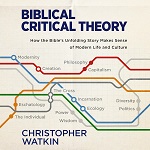
Biblical Critical Theory
Christopher Watkin
Zondervan, 2022
I recently finished up co-teaching a Sunday school class on Christopher Watkin’s Biblical Critical Theory. These are the notes I took for the class, with my personal comments preserved as footnotes - some of which are explanatory, but most of which are, sad to say, critical. It was only a 12-week class, so we weren’t able to cover the whole book. Therefore, the notes only cover selected chapters.
I had some pretty significant issues with the book. First, there is the title, which suggests that the book will offer a biblical version of the critical Marxism/post-modernism in vogue today… but it does not. In fact, I don’t think Watkin even understands what “critical theory” means. Basically, what Watkin does is use an imprecise systematic theology to show how much common ground biblical theology shares with philosophers like Derrida and Nietzsche, while also railing against Western modernity and showing how Christianity is a superior alternative.
His main strategy for this is what he calls “diagonalizing” — in which he first delineates two extreme or reductive modern views, and then articulates a biblical concept that reconciles or complexifies the two. Sometimes this provides genuine insight into our modern situation and proves Christianity a robust alternative. Other times, his analysis is strained, if not outright incorrect, and his “diagonalization” is vague and unhelpful. (And for every instance, there is a diagram showing the two ideas in separate boxes, and the Biblical idea diagonally superimposed between them, which adds essentially nothing to what’s been stated in the text.) When it comes to politics, in particular, Watkin is short on concrete/practical examples, and tries to play to both sides of the spectrum with simplistic and glib analysis (e.g. his mention of Brexit and his lip service to social justice). But he also takes glee when Christian theory pisses people off, as when it generates “enough scandal to make a card-carrying modern red in the face with indignation” (357)… the kind of divisive hyperbole he elsewhere sharply condemns.
The book is not organized by topic, nor by stages of a developing argument, but mirroring the structure of the Bible — beginning with creation, moving on to Abraham and Moses, and so forth, and finishing with Revelation. Since the book is essentially a systematic theology and philosophical critique — not a commentary — this structure does not serve its purpose. Watkin tries to cover so much ground that even at 600+ pages, many of his more complex points are underdeveloped. At the same time, because of the structure, other more basic ideas he belabors and repeats, and moreover, bloated with purple prose and “cute” asides, as when he laments that his coffee cup is half empty. It’s hard to tell who the intended audience is. It’s unwieldy, badly in need of editing and/or revision. It seems like it got away from him early on in its writing, mainly due to the structure he chose.
I imagine writing a non-fiction book is like going down to the beach to skip rocks. You survey the area, taking stock of your subject matter; then you choose the data and arguments best suited to your purpose — ones which are smooth and flat, which you think will skip well. And when you have a sufficient number, about what you can hold in one hand, you skip them with your other hand. How many times they skip and how far they go depends on your technique, and how well-chosen they were.
Christopher Watkin is like a kid who toddles down to the beach, reaches down, grabs two fistfuls of pebbles and just chucks them straight into the water. Clearly, Watkin is well-read, but he references so many different figures that his argument/commentary on each is uniformly brief (and occasionally inaccurate), and discussion is so disorganized, it’s sometimes not even clear why he brings them up. Most of the time, I felt like I would have been better off just reading Chesterton, Lewis, Keller, Ricoeur, Augustine, or any of the other authors he cites. Some of the final chapters rely on lengthy summaries of a single author or work, like the “reports” you used to do in gradeschool. When he does critique, the results are, shall we say, mixed. I appreciated his references to Heidegger and phenomenology here and there, but his critique of Kierkegaard is brief and simplistic, and he misreads/misuses Plato pretty badly. Curious also how often he uncritically cites David Bentley Hart who holds a number of heterodox views.
There’s some ok stuff here, but it can all be found in other, better-written and organized works, with fewer errors.
Introduction
Chapter 1: Trinity
Chapter 2: Creation
Chapter 3: Humanity
Chapter 4: Sin and Society
Chapter 5: Sin and Autonomy
Chapter 6: Sin, Anthropology, and Asymmetry
Chapter 7: From Lamech to Noah
Chapter 9: Abraham and Promise
Chapter 10: Abraham and Covenant
Chapter 14: Wisdom Literature
Chapter 25: Eschatology and Apocalyptic
Notes
Introduction (pp. 1-32 … lengthy)
“So What?” — practical application/relevance of Christian doctrine (1-2)
Goal: “My aim in these pages is to paint a picture of humanity and of our world through the lens of the Bible and to compare aspects of this image to alternative visions.” (2) … also, to make Christianity appealing (3) and refresh/clarify for modern people who misunderstand Chrisitianity, and/or predisposed against it (3)
Defining terms
“Culture” - broadly defined, touching “every aspect of how we live in the world” (borrowed from Keller) (4)
“Figures” — elements of culture, which “describe the sorts of truth that can be produced in a given culture, the shapes and rhythms that must be followed if an idea is to be counted as truth.” (7)
Watkin distinguishes between “figure” and “ground” in a sense similar to Gestalt psychology — in which “figure” is the object of attention, and “ground” is the peripheral context in which the figure appears. He proposes to “broaden the figure-ground distinction from a way to describe perception into a theory of knowledge and ethics and a way of understanding how we live in the world.” (5) All experience is meaningful — all experience is experience-as — and it is figures which arbitrate meaning: “All our experiences follow the as-structure, and different figures predispose us to favor some experiences-as over others.” (6)1
Categories of Figures:
• Language, ideas, and stories (e.g., “subtraction stories” in Charles Taylor)
• Time and space (e.g., absolute/Newtonian)
• The structure of reality (metaphysics, ontology)
• Behavior (e.g., shaking hands; conversational rituals; “getting coffee”)
• Relationships (e.g. rules governing friendships, romantic partnerships, social organizations/clubs)
• Objects (suggestive of social practices, e.g. a podium; coffee)
Since these “figures” inform our baseline/background understanding of the world, our relationship to them is unique. “We do not have the luxury of resisting these cultural figures from the outside; they are always already part of us on the inside. They are us. … Take away all culture, and we have no person left.” (9) Moreover, they cannot be reduced to one category which explains the others; they are complex, interdependent. Also, these categories are not exhaustive.
Watkin proposes bringing Biblical “figures” into conversation w/ modern “figures”2
Examples of Biblical Figures:
• Language, ideas, and stories: “the first shall be last”; redemption narrative
• Time & space: rhythm & promise of fulfillment; God not localized (but see Deut. 12 and Josh. 22 — tabernacle at Shiloh); beginning & end
• The structure of reality: kingdom of the world vs. Kingdom of God; heaven vs. earth
• Behavior: Christian worship; works of charity
• Relationships: unity of all believers in the body of Christ; equality as image-bearers
• Objects: architecture of the tabernacle; the cross3
“World” — an ensemble of figures. Like Charles Taylor’s “social imaginary,” “a cluster of ‘images, stories, legends, etc.’ that legitimate common practices.” (11) e.g., “the business world” or “the world of Star Wars.”4
Presumably, bringing “figures” from one “world” into conversation w/ those from another will bring the worldviews themselves into conversation.5
“World” is not limited to human consciousness, or even humanity as such — “A world is not only what is perceived by a human consciousness; it can include networks of machines or ecosystems that rhythm and pattern reality just as effectively or extensively as any human actor.” (12)
Worlds are not static, especially when encountering other worlds (the term, which he borrows from Ricoeur, is “refiguration” — for example, bringing one’s “world” to bear on the “world” of a text) (13)
Disclaimer: the Biblical figures he will discuss are not necessarily embodied by the Church’s actual practice, historical or contemporary. In many cases, these are actually in tension (e.g., broad Christian support for slavery pre-abolition). “What I am presenting in this book is Christianity at its best…which is all too often not the Christianity of Christians” (14)6
“Engagement” (here, more of a disclaimer than a definition) — implies some prior separation, but: “Culture and religion are entangled, to the point where we find it hard to work out which idea or behavior belongs to which” (14) … “the figures of our own culture are so thoroughly derived from biblical patterns and rhythms, and the figures of the Bible are so clothed in their cultural contexts” (14) … “Trying to separate Christianity from culture is like trying to extract the flour from a baked cake” (15).7
Nonetheless, our culture offers various ideological camps/positions which often present a falsely dichotomous dilemma born out of ignorance and distortion of their original source, the Bible.
“We live at a peculiar moment in history when our culture’s assumptions and values retain a deeply Christian imprint but when the teachings of the Bible are largely unknown, misunderstood, or condemned.” (15) … “the Bible’s figures cut across the range of options presented to us, only to find on further inspection that those options were themselves distorted and dismembered versions of biblical ideas.” (15)8
This brings him to his crucial concept:
*“Diagonalization” — sort of an inverse dialectic, in which two opposing cultural views or options are both shown to be fragments or reductions of Biblical truth which satisfies their underlying motives. (More significant than the space I’m giving it here) (16-17)
He argues that there is a long history behind this idea (17-19) which authenticates it.
Two disclaimers:
1. It is not a middle-of-the-road compromise (19)
2. It is not postmodernism (20)
The point with (2) is that good and evil are mixed up everywhere in the world, so all viewpoints reflect some measure of truth and goodness — but there is truth and goodness to be sifted out (in contrast to relativism). (20-21)
“Out-Narrating” — basically showing that Christianity has the resources, depth and coherence to make sense of world/experience, whereas competing narratives are Procrustean beds where element(s) of the world are reduced into others, explained away, or lopped off entirely (e.g. evolutionary psychology’s take on religion) (22-23)9
Thus, the Christian narrative can’t be accurately represented or understood from within one of these competing worldviews/narratives/“worlds” (24 — presuppositionalism?)
The plan for the book
Watkin makes a couple of notes about structure: because his argument is about Christianity as a narrative, the organization of his book will follow the narrative shape of the Bible. Moreover, unlike the two-part structure of Augustine’s City of God, Watkin will present critiques of modernity side-by-side with the Biblical alternatives throughout the book (25).
He then goes on to say that the job of out-narrating is neither wholly destructive (merely a means of breaking down modern alternatives) nor affirmative (simply endorsing whatever in culture is good); it does both. Key to its success is not only listening to multiple viewpoints, but understanding the motivations behind them. “Christians engaging with cultural theorists must understand not only what they are saying but also why they think it is a good thing to say. Until we can…see why their position is not only true but good and beautiful to them…then we have not yet come to a point of being able to critique it.” (27)
Distinguishing “biblical critical theory” from other social theories
Examples of social/critical theories include Marxism, the Frankfurt school, psychoanalytic theory, etc. Social theories are broadly explanatory and self-confirming; they not only draw conclusions from salient features of human experience and the world, but they determine what the salient points are to begin with. (28-29) Watkin says biblical theory differs from these in that it (1) presents not only a critique, but also a positive agenda, (2) challenges common thought, (3) is nonpartisan, and (4) seeks to conform to the image of Christ. (30-31)10
Questions for discussion:
1. How do you understand the idea of “worldview”? What is your understanding of what Watkin is proposing to do with his book?
2. What is your understanding of, and/or experience with, critical theory?
3. What is one theological idea that seems irrelevant to daily life — of which you find yourself asking, “so what?”
4. Why might someone in our culture find Christianity unappealing, and/or find atheism (or some other option) more appealing?
5. Perhaps on a related note: what misunderstandings of Christianity have you encountered? What misunderstandings seem to be most common?
Chapter 1: Trinity (pp. 33-52) — or, What is ultimate reality?
Short answer: ultimate reality is, or is grounded in, the God who is love, which means reality is meaningful, absolute, personal & relational.
Reality is Personal
After some introductory discussion (33-34), Watkin lands on the idea of “ultimate reality,” invoking questions of ultimate/cosmic origin and ontological fundamentality. The Bible posits reality as based in a God who is concrete and personal. (35)
Then, alluding the problem of universals (which comes up throughout this chapter), Watkin asserts, with the help of C.S. Lewis, that ultimate reality must be concrete and individual, otherwise there would be no accounting for particular instances of general or abstract principles. (36)11
Watkin then adds that the idea of the inherent dignity of human beings requires concrete/individual reality as its basis. He argues reductio ad absurdum that the atheist’s impersonal cosmology means that individuality is either temporary or illusory (or both), thus cannot support the idea of dignity and individuality. He concludes that we must choose between this and Christianity’s radically personal cosmology.12 (37)
Reality is Absolute
Watkin moves on to the Christian view of God and creation as absolute — in contrast to the fractured & unstable cosmos of, for example, the Greek Pantheon (though some passages in Greek literature suggest that the gods are subject to aspects of fate, morality, etc.). Thus follows his first exercise in “diagonalization”: showing how Christianity reconciles and expands upon the dilemma of an ultimate, impersonal reality and an unstable, personal reality with “absolute personality theism.” (38)13
Watkin applies this idea to the realms of science and art. Speaking on science, he notes (echoing Charles Taylor et al) that, historically, it was Christianity that first conceived the universe as an orderly, predictable system, and thus laid the groundwork for science as we know it. (39) Regarding art, God’s personality legitimizes artistic expression, and the universe as something for aesthetic regard. He then “diagonalizes” the arts and the sciences with, again, absolute personality theism. (40) He observes that two modern neuroses arise from emphasizing one or the other: logical positivism and scientism on the one hand, and overly emotional romanticism on the other. (40)
Reality is Relational
After some introductory remarks dealing with the fact that the word trinity does not occur in the Bible (41), Watkin returns to the problem of universals, positing that God’s trinitarian nature provides a response. Because God is both one and many, the question of which is prior is ultimately invalid. Rather than simply “solving” the problem, Watkin suggests that the doctrine of the Trinity challenges us to rethink (or does he mean abandon?) our logical categories altogether. (42-43)14
Extending this discussion into the social & political realm, Watkin “diagonalizes” two forms of society: one in which community subsumes individuality, and the other in which individuality is dominant. In an ideal Trinitarian society, social living and individual identity work together in harmony. (44) At the practical level, after remarking that political theories tend to gravitate towards poles of figurehead authoritarianism (emphasis on “the one”) or communism (emphasis on “the many”), Watkin advocates a political theory based on the idea of “the few” — mediating organizations, usually at the local level, exerting more power than an individual alone could, but in which an individual would feel heard. As an example of this, he mentions British trade labor unions. (45)
Reality is Love
Watkin explores the idea that God is love, as opposed to the idea that God is loving. (46-47)
Here Watkin again encounters the one-and-many problem, this time in the arena of linguistics and anthropology. Modern linguistics focuses on how language deals in discreet categories, grouping things—and people—together. But it raises a question: how to justify these categories when speaking about people, since another person is inherently, totally different from you? Categorizing another person appears to simpify & reduce them in a way that does violence to their individuality (the technical term for which is alterity).
The Christian alternative, as Watkin puts it, is: “The other person is infinite (in the sense that I can never fully understand them) but not infinitely removed from me in inaccessible loftiness as in the logic of sameness and alterity…the other is both my fellow beloved creature and an utterly unique and irreplaceable singularity.” (49) Watkin will revisit this idea later, in Chapter 18, p. 416.15
He connects this idea to the competing ideals of a dominant will to power and a self-effacing will of submissive love. Though he doesn’t do so, loveless power vs powerless love seems an obvious candidate for diagonalization and political application. The result of diagonalization would appear to be: “Christian Trinitarian theism has a will-to-charity (agapē), and this inscribes self-giving rather than the libido dominandi (will-to-power) at the heart of reality.” (51) (Does he complete this thought on p. 164, 262, or 405?)16
Questions for discussion:
1. How can we can expand on Watkin’s political discussion (p. 45)? What are other practical applications of the “one-and-many” idea?
2. Where have you encountered opposition to science? To art? How should we counter this opposition? (Or should we?) How can we expand on Watkin’s diagonalization of the two?
3. In addition to the diagonalization of science and art, what might be some other real-world implications of absolute personality theism? (I’m reminded of something Chesterton said about overturning the assumption that a universe that behaves with regularity is therefore “dead.”)
4. Why do you think an atheist might be more attracted to the idea of an ultimately impersonal material universe as opposed to a cosmos reflecting the personality of a personal creator?
5. What would be a practical example or application of Watkin’s “will-to-charity”?
Chapter 2: Creation (pp. 53-81) — or, Superabundance and Dominion
Watkin starts this chapter by emphasizing (1) God’s ownership/dominion over creation by virtue of his being the creator, (2) human responsibility to creation and its creator, and (3) the fact that the universe had a beginning. (53-54) He emphasizes (3) because it suggests that the universe is not necessary; God did not need to create it; it does not need to exist — the universe is gratuitous. (More on this last idea p. 59ff).
1. Distinctives
A peaceful and orderly process
Whereas other creation stories typically feature violence and conflict among the gods or the elements, the Biblical creation story differs in that it is “remarkably calm and ordered” … “the bedrock reality of our universe is peace, harmony, and love, not war, discord, and violence.” (55) In this way, creation reflects the character of its creator.
Related but distinct realities
On the other hand, the fundamental distinction that Genesis 1 emphasizes is between God and creation. These two fundamental categories of reality (God / not-God) are asymmetrical. “The universe depends on God for its existence, but God does not depend on the universe for his.” (56) Modern philosophy often tries to reduce reality into a single category or essence: materialism & pantheism are obvious examples, but also Greek & Roman polytheism in which the gods’ mode of existence is similar to that of mortals. (57) Christianity’s view of reality is distinct in a few other ways: there is no mediator or “demiurge,” there are no rival gods, and God is not just a bigger/better version of humanity. (57)17
Categories of deity
Traditionally, mankind has conceptualized deity in terms of transcendence vs. immanence. To be transcendent is to be ultimately beyond knowledge and experience (e.g., Plotinus’ “the one”?). Likewise, to be immanent is to be common to everday life (e.g., Greek/Roman gods?). In a way, God is both, and yet neither. Watkin points out that “the main reason for God’s transcendence or exaltation is not his metaphysical otherness but his blazing holiness.” (58) God is imminent in the sense that “he is intimately involved with his world and rules over it sovereignly,” but is transcendent in that he does not share an identity with the world. (59) Though not explicitly stated, this diagonalizes transcendent-unknowable-unapproachable vs. immanent-familiar-nearby.
Grace
Watkin then returns to the idea that the universe is gratuitous or contingent, rather than necessary or eternal. He goes out of his way to emphasize this point in particular: “I cannot overstress how fundamental and distinctive this figure is to a Christian view of reality.” (60) The reason is because “[i]t is something that surprises, something that makes us sit up and take notice… places us in the posture of recipients. …our fundamental orientation to existence [ought to be] one of praise and thanksgiving.” (60) (This echoes the emphasis on reality as fundamentally personal, pp. 35-37, 46-47.)
Pathos
The contingency of the universe produces pathos for creation: the fact that creation did not have to be created is sufficient to warrant the sense that creation, and the things in it, are beautiful, delicate, and full of dignity. Watkin contrasts this with a modern paradigm called “pathos of finitude” (no source for this) — in which life, beauty, etc. are dubbed meaningful because their limited time on earth makes them precious. Advocates of this view argue that “a Christian view of eternal life…cannot invest existence and huamnity with the same delicate, ephemeral dignity.” But Watkin contends that the “pathos of contingency” makes room for the same sentiments. (61)
Certainty & chance
With the concept of gratuity, Watkin diagonalizes the principles of certainty and chance as fundamental to reality (though not with an accompanying diagram). The universe and/or its existence is not the inevitable result of a predicable chain of events or of logical necessity; but neither is it purely random/meaningless. God’s decision to create was a free choice, the opposite of which was really available to him; yet God’s will is not arbitrary, but an expression of his love.
Watkin applies this diagonalization to the field of economics. He sees economic theories and modes as typically gravitating toward the poles of certainty or chance. On the one hand, the market paradigm seeks to control society (and, ultimately, all reality) on the basis of commodities (which also he sees reflected in religions which are essentially transactional). On the other, these sorts of projects are continually thwarted by chance events, which sometimes tempts toward abandoning them altogether.
But he contends that both of these are “reductive misrepresentations from the outset of a full-orbed biblical paradigm: necessity misunderstands the character of the God who ‘cannot disown himself’ (2 Tim. 2:13), and chance seeks to understand generosity and spontaneity without the resources of absolute personality theism.” (64) The Christian ideal, true to the gratuity of existence, “provides the pattern for a society of compassion, of helping the needy when they have no means to pay back, of reaching out to the poor and the ungrateful when they are unable to repay” (earlier on 64).
2. The Uncreated
The “formless and empty” pre-creation cosmos is “not only a metaphysical idea but also a practical threat, the monster of chaos that stands at the door of our cultural worlds today.” (65) We see this embodied in, for example, post-apocalyptic films, but also in Samuel Beckett’s play Endgame. Contrasting the characters in the play who are overwhelmed by the “breakdown of form and fullness” (66), Watkin notes, “God is not constrained by the given circumstances, even if those circumstances are formless, empty, and dark.” (67).
3. Language & Enchantment
God’s speaking creation into existence “implies community and relationship.” (68) This diagonalizes two trends in philosophy. On the one hand, “some Continental thinkers, such as Jacques Lacan, consider ‘the Real’ beyond our experience to be an undifferentiated, unthinkable flux that our language…‘cuts’ into comprehensible portions.” On the other hand, for “thinkers…in the analytic tradition…if we eliminate ambiguities and contradictions in our language, we will make reality utterly transparent to our thought.” (69) The result of diagonalization affirms that “language does shape reality,” but that it is God’s language which “perfectly describes what there is…that when it is spoken, things are so.” (69)18
The interrelation of language and reality lends itself to the idea that the universe is enchanted. (69) Elaborating on this idea, Watkin challenges other reductive views, namely materialism and spiritualism. “[B]oth ‘pure materiality’ and ‘pure spirituality’ are reductive heresies of [a] more complex enchanted-embodied reality.” (70) Enchantment “also diagonalizes the dichotomy between magic and disillusion that characterize modernity’s attitude to the supernatural: either an arbitrary capricious spirituality…or a bare absernce of anything but time, matter, and chance.” (70)
4. Variation and Fullness
Watkin points out that creation isn’t drab and utilitarian, but varied and abundant. Why? “God created a superabundant world fit to foster the flourishing of his creatures.” (71) Diversity and abundance isn’t an accident of nature, but a choice of its creator. Thus, creation itself suggests there’s more to life than mere survival. Nonetheless, the universe does function—it’s not there just to look pretty. With a quote from Augustine, Watkin diagonalizes beauty and utility. (72) In the same vein, Watkin places order and creativity on two ends of a spectrum, explaining that God’s creation, like a Bach fugue, embraces both (strong echoes of the art-and-science diagonalization on p.40). (73-75)
5. The Good
This section explores the implications of “God saw that it was good.” Right away, Watkin diagonalizes the categories of objective and subjective (75). He reviews Descartes’ original inner/outer distinction, as well as Kant’s failed attempt to reunite the two (76). The diagonalization, as Watkin articulates it, is that “all reality is indeed interpreted, but the authoritative interpreter is God” (76). For Watkin, this seems to have primarily ethical implications: “when God sees something as good, he sees it rightly.” (76)19
Watkin elaborates on this solution by giving an odd Marxist twist to the objective/subjective poles: “the ‘it was good’ of Genesis 1…avoids the trap of the exclusively subjective—namely that only power and violence are left to arbitrate between competing interpretations—and it avoids the trap of the exclusively objective—namely that the dignity of individual creativity vanishes in a puff of metaphor.” (77) 20 Watkin adds into this discussion Augustine’s remark that the subject/object distinction is an illusion born of sin (!), which Watkin clarifies is “the sin that reduces love to mastery, praise to possession, and creation to calculation” (77)21.
Watkin then applies these thoughts politically. He sees classical liberalism (mostly modern-day Republicans and Libertarians) as tending toward objectivism in that it is neutral toward any particular vision of “the good”; and progressivism (mostly modern-day liberal Democrats) as tending toward subjectivism in that it is pluralistic. Again, God as an “ideal observer” mitigates the two: “the good” is not objective (or eschewed altogether) because it is a viewpoint—but it does not collapse into the mire of subjectivism where all other viewpoints that are equally valid. (77-78)22
Watkin observes that, in light of this diagonalization, “the world has value before and outside of us human beings. This is an important point to make today, because there is a strong pushback in many quarters against an anthropocentric view of value that, the argument goes, leaves humans with a dangerous monopoly of power to abuse and exploit the world.” (78)23
Watkin concludes this portion by diagonalizing two other concepts: fact and value. As modern people, he points out, “we consider ‘facts’ to be public and universal, and ‘values’ to be private and subjective.” (78) In contrast, “for the Bible, values are factual and facts are valuable, but…[i]t would be better to say, using biblical language, that the ‘it was so’ and the ‘it was good’ are just as fundamental to God’s creation as each other and that—like the one and many that we encountered above—once we begin to treat them as separate, we have already fallen prey to reductive, heretical thinking.” (79)24
6. Rest
Watkin notes: “[T]he purpose of creation is far from exclusively anthropocentric and far from simply productive. … God’s rest makes clear that work is not all there is for God, and…he doesn’t want it to be all there is for us either.” (79) With Biblical rest he diagonalizes, essentially, workaholism and acquisitiveness/consumption (80). In conclusion, he references Camus’s Myth of Sisyphus as a picture of the futility of labor & production as ends in themselves25.
Questions for discussion:
1. What do you think of the notion, according to Augustine, that the distinction between object and subject is “an illusion born of sin” (p. 77)?
2. Despite Watkin’s promise in the opening chapter to explain the “so what?” of Christian doctrine, these first two chapters seem very heavy on abstract philosophy/theology and short on practical application. What is the practical use of, for example, the first five distinctives of creation that he names?
3. Does Watkin’s God-as-ideal-observer notion hold up to scrutiny? What are its merits? What are its problems?
4. What is your understanding of the nature and role of language? What might be some practical implications of Watkin’s discussion of language on p. 69?
Chapter 3: Humanity (pp. 83-106) — or, Image of God and Dominion over Nature
Watkin begins introducing the idea of human exceptionalism: that humans are in some way set apart from everything else in existence. (He references Kafka’s short story, “A Report to an Academy,” and the film Planet of the Apes, which satirize the idea.) To the question of what sets human beings apart, the Bible answers that “human beings are made in the ‘image of God.’” (84)
Distinctives of Man’s Creation
Human beings are unique, yet they share something in common with other animals and with the earth itself (“adamah” means “earth”). (84) Significantly, the plural “us” pronoun is used only during the creation of man. Moreover, man is uniquely commanded to subdue and rule over nature, and is the only creature that God speaks with. (85) There is a progression of language beginning with God’s acts of creation and culminating in Adam’s song. (86)
The Essence of Man
Watkin catalogs various philosophers’ definitions of the uniqueness of man (86):
• Locke: understanding (echoes of Aristotle, Aquinas, etc. “rational animal”)
• Rousseau: free-agency
• Adam Smith: division of labor
• Tocqueville: self-improvement
• J.S. Mill: sympathy
Darwin considers man different from other animals in degree, not in kind; therefore he dismisses the idea of human exceptionalism. Others (e.g. transhumanists) argue that mankind has no fixed nature; the only constant is change, via technology and inner growth. (87)
In contrast to all these ideas, Watkin interestingly points out that in fact the Bible “explicitly does not name what it is about human beings that makes us in the image of God” — there’s no concrete property or attribute which constitutes man’s essence. This is significant when it comes to specific cases which might tempt a secular person to deny that a person qualifies as “human”, in that they lack some essential quality — consciousness, sympathy, feeling/emotion, the ability to self-improve — e.g., the disabled, elderly, unborn, comatose, etc.26 (88)
Humanity’s Self-Transcendence
Quoting such diverse figures as Gregory of Nyssa, Mirandola, Pascal, Chesterton, Berger, and Sartre (89-90), Watkin recognizes that “human beings do progressively change their environment and living conditions, and…these changes transform human beings themselves. Unlike all the other animals, we do not stay where we are as a species.” (90) Taking this idea to an unhealthy extreme is posthumanism or transhumanism, which aims to maximize and direct mankind’s development using technology and, usually, totalitarian control. The issue here, (with a nod to C. S. Lewis’s Abolition of Man), is that posthumanism “ossifies the vision of the good life in a particular cultural milieu at a particular moment in time, and locks it in for the foreseeable future” (91)27. I’m gonna go ahead and quote from The Abolition of Man:
Each generation exercises power over its successors: and each, in so far as it modifies the environment bequeathed to it and rebels against tradition, resists and limits the power of its predecessors. This modifies the picture which is sometimes painted of a progressive emancipation from tradition and a progressive control of natural processes resulting in a continual increase of human power. In reality, of course, if any one age really attains, by eugenics and scientific education, the power to make its descendants what it pleases, all men who live after it are the patients of that power. They are weaker, not stronger: for though we may have put wonderful machines in their hands we have pre-ordained how they are to use them.
At the other extreme, “some have resisted any intervention to improve the lives or capacities of human beings.” (91)28
Watkin diagonalizes these two extremes, positing a via media expressed in the “biblical question ‘how can we best glorify God, love him, and love our neighbor?’” (92) — a paraphrase of the Westminster Catechism, itself basically an articulation of mankind’s telos according to the Augustine/Aquinas tradition. (Watkin stops short of commenting on practical application of this idea, which he says would take another book.)
Developing this idea further, Watkin considers the language involved in “image” and “of God.” From the latter, Watkin concludes that “I do not ultimately own or define myself” — it places guardrails and limits on self-improvement and change. On the other hand, as the only thing in creation described as the “image” of God, humanity is set apart as uniquely dignified. (93)
Human Worth in Both Extremes
Watkin then challenges (diagonalizes?) the extremes of thinking oneself of “supreme worth” or of “small worth.” (93) He notes that, in popular consciousness, both of these co-exist together uneasily (see Chesterton quote on p. 94). He identifies them as corresponding to other philosophical ideas (94):29
| Watkin | Plantinga | Nietzsche |
|---|---|---|
| Supreme worth | Creative antirealism | Superman |
| Small worth | Perennial naturalism | Last man |
Without holding on to both extremes of the imago dei at once, the temptation is to gravitate toward one extreme or the other. (95)
Humanity Conceived in Non-Human Terms
Another temptation is to understand humanity in terms of something else in creation: whether it be animal, or machine. (95) “Humanity has been thought in the image of a computer, the solar system, many different animals, and much more besides.” Ultimately, these are “counterfeit and dehumanizing identities.” (96)
Mankind’s Rule & Dominion
Creation was made with the intention of collaboration; man is the intended collaborator. “It seems that God’s intention from the beginning was that the ground would need to be worked.” (97) Watkin likens this collaboration to “improvisation” (citing Bruce Benson and C.S. Lewis) and “subcreation” (citing J.R.R. Tolkien) (97-98). Thus, mankind’s participation “is not a work of primary creation,” but “riffing on a theme already present in God’s created order.” (97) We are not gods — we can’t just do whatever we want and make reality as we see fit — but we help shape the world, and ourselves, in a way that no other element of creation does.
A primary exampe of this is Adam naming the animals. Watkin reiterates: “Adam’s task here finds its place between utterly unconstrained creativity and utterly passive rule following.” (99) Name-giving — applying language to the world — is especially significant in that, in a sense, it imparts meaning. “To name something is to call it out from the flux of the world” (99).30
Following this, Watkin discusses how this power of language can be abused in the interest of attaining or preserving social or political power. (100)31
On a similar note, Watkin comments that a distortion of the command to cultivate the earth has led to the abuse of native populations—qualifying his argument32 with the caveat that not all indigenous cultures are good merely because they are indigenous. (101)
Caring for Nature, our Sister
Watkin quotes historian Lynn White, Jr., who in an article titled “The Historical Roots of our Ecological Crisis,” blames modern society’s abuse of natural resources on the influence of Christianity. White suggests that pagan beliefs cultivated a greater respect for nature, and thus help preserve it from harm. In doing away with those beliefs, Christianity opened the door for unrestrained exploitation of natural resources. (102) Watkin criticizes paganism as essentially arbitary in what it designates as sacred. (103) He then diagonalizes the two extremes (environmental exploitation and pagan reverence for nature as divine) with God’s command to “fill the earth and subdue it, and have dominion” (104).33
C.S. Lewis and G.K. Chesterton have both suggested it more appropriate to refer to nature as a “sister” rather than a “mother,” because “we seek to protect and care for nature like we would a sibling, a fellow part of God’s creation” (105). Watkin argues that without belief in God, the only way to justify care for the environment is to put it on an ontological level equal to human beings. Otherwise, the ethic of violence (“might makes right”) prevails. (105-106)34
Questions for discussion:
- In your own experience, what are theories of human being or essence that you’ve encountered? How have you responded, or thought you should respond, to these ideas? Does anything in Watkin’s chapter give you food for thought?
- What are some strategies for applying the human telos (p.92) to specific ethical questions and situations? (I’m reminded of Pedro’s talk on bioethics.)
- Regarding p. 99-101, what do you understand to be the relationship between thought, society, and language? (Consider also Watkin’s remarks pp. 47, and 68-69.) How does language become a tool to achieve or preserve political power? What can be done about it?
- Watkin recommends for “Christians, wherever practicable, to use biblical language to describe the world” (101). What are some ways we already put this idea into practice? What are some additional ways that we could? What might be some difficulties in doing so? Are there ever times when we shouldn’t?
- Environmentalism is generally a tenet of the political left, whereas Christians usually gravitate toward the political right. Why do you think Christianity and environmentalism are seldom part of the same political package?
Chapter 4: Sin and Society (pp. 107-132) — or, The Noble Lie; or, Fault Lines in Society and the Self
Watkin argues that despite its unpopularity, the Christian doctrine of sin and judgment provides “a great resource that can help develop winsome, penetrating, and fresh analyses of cultural trends as well as distinctive, constructive contributions to today’s social and intellectual debates” (107).
Attitudes toward the doctrine
Secular culture resists this doctrine because it appears to impose a “narrow idea of right and wrong” (108) and come across as “hate speech,” prudishness, & judgmentalism (109).
Watkin identifies two misguided ways in which Christians are tempted to respond:
- Minimize or ignore the doctrine, preferring instead to emphasize more agreeable & positive aspects of Christianity in order to build inroads with the culture. Watkin critizes this approach as “struggl[ing] to offer anything more than a warmed-over version of the latest fashion in social theory” (110).
- Double-down on the doctrine with a hellfire and brimstone approach. The error here is that “this stance abandons the ambition of joining humbly and constructively in the social and intellectual debates of the day,” (110) and emphasizing separation from the world.
Watkin posits that these errors result from the failure to recognize that the doctrine of sin and judgment “in fact strengthens and huamnizes a society” (110). Despite its negative appearance, it can provide a “fresh, truthful and, yes, positive vision” (111).
The Biblical account of the fall
Watkin notes some important features & implications of the fall in Genesis 3 (pp. 111-113):
- The serpent/Satan is a creature, and therefore falls w/in the hierarchy of creation; not an equal opposite to God
- The serpent’s speech is disingenuous (not asking questions out of curiosity… duh?)
- Eve’s exaggeration of God’s command plays along with the devil, marking the birth of false religion
- To “know good and evil” and “to be like God” really means to choose good and evil for oneself, independently of God
- Eve’s choice is an attempt to defy the order of creation (see ch. 2 & 3)
- Adam is with her during the whole episode, saying and doing nothing, thus bears responsibility also
The Noble Lie
Watkin identifies Satan’s deception as the first instance of a “noble lie,” “a falsehood told by an individual or group in power with the aim of manipulating those under their power into doing what otherwise they would not do, often with the veneer of a noble purpose” (113). Specifically, Satan suggests that Eve is being held back from her full potential by God’s moral constraints35.
The idea of the “noble lie” derives from Plato’s Republic, Book III. Socrates proposes that the people of his ideal city be taught a myth that they are made by God from different metals, from which their place in society is ultimately derived. After the first generation of rulers, who invented the myth, passes away, everyone will believe the myth. The purpose of the myth is to encourage the people care more for each other and the city.
Watkin equates this idea with “the modern practices of dishonest marketing and…political propaganda and spin”, which sees success in “social harmony,” no “inconvenient revolutions,” as “profits are made” and “sin enters the world” (114).36
The “noble lie” divides society into the elite who see the lie for what it is, and the masses who accept the lie; fracturing the conception of the good. Thus, the primary effect of the “noble lie” is division, resulting in alienation and resentment. This was Satan’s approach, and the result he achieved — and Watkin sees this as essentially how society works, too (116). In contrast, God, even though he may not tell us everything, tells us only the truth, even if it is sometimes a hard truth. (115)
Equality
In addition to bearing the image of God, humans are alike in their condition of sinfulness. Thus, Christians can justify the idea of human equality from opposite directions. (116) (This in contrast to the humanist view that humans are equal because of their equal goodness, critiqued by C.S. Lewis, p.118.) On this basis, Christians can, and ought to, critique social inequalities (117). Democracy as a form of government accords with humanity’s dual nature: it honors human dignity by giving each a voice in government, but also accounts for sinfulness by decentralizing power (119).
The Suppression of Truth in Romans 1 and Modern Thought
Despite modernity’s resistance to the doctrine of sin (and Christianity in general), the doctrine finds echoes in the work of many modern thinkers: for example, Marx, Freud, and Nietzsche (120). In regards to Freud: although Freud sees religion as a symptom of repression, the idea of repression itself echoes the idea in Romans 1 that human beings intentionally hide the truth from themselves (120-121). In Marx (and Marcuse), truth-suppression appears in the form of ideology. Though Marx mistakenly locates truth-suppression as primarily external, more modern thinkers like Sloterdijk and Horkheimer have observed how individuals wilfully blind themselves with ideology (121). Lastly, Nietzsche characterizes Christian ethics as self-blinding “slave morality”, a narrative of defeat rationalizing weakness and quietism. Odd as it may seem, Watkin claims that Nietszche’s project also finds common ground with Romans 1. (122)37
Hermeneutics of Suspicion Biblical Self-Critique
The “hermeneutics of suspicion,” coined by Paul Ricœr, approaches a text or artifact with the intent not of interpretation or analysis, but of revealing hidden motives behind its creation, of its creators. (For example, whenever you interrogate a claim made in an advertisement that betrays its creator’s intent to make money.) (122)
Misinterpreting this notion as one of self-critique38, Watkin calls it “profoundly biblical” (122), and likens modern critical theory to the Bible’s “relentless undermining of idolatry” (123).39 Quoting Merold Westphal, Watkin cautions against two potential errors: self-righteously employing critique only towards others, and self-abasingly directing critique only toward the self (123). He also cautions against maintaining the critical stance more or less permanently, resulting in cynicism; instead, he encourages what Ricœr calls a “second naiveté,” and what C.S. Lewis calls “reenchantment” (124).
Fault Lines in the Self
The dualistic idea that there are two classes of reality — good and evil — has a long history. In Western philosophy, it begins with Plato’s distinction between form and matter, continuing through Descartes’ mind/body distinction, along with comtemporary body/soul dualism. Typically one side of the dualistic distinction is seen as superior to the other (forms in Plato; mind in Descartes and, to a degree, Kant; soul in modern thought). (125) Watkin mixes and matches these distinctions as form vs matter, grace vs nature, and freedom/personality vs nature/science, noting that various figures have emphasized different sides of the divisions (e.g., the romantics emphasized imagination and emotion over reason). (126) Divisions have also been made with reference to social groups (e.g. Marx). In any given case, the dominant narrative is that one side must be overcome by another through some sort of struggle. (127)
Christianity differs from all of these in that the fault line between good and evil runs down the center of every individual, every aspect of society, every element of creation/nature. (127)40 Watkin’s diagonalization is “Creation — Fall — Redemption” (128).
Fault Lines in Society
Watkin applies this to political paradigms which tend to divide groups into categories of oppressor/oppressed. He responds that the only perfect victim was Christ; the true oppressor is Satan; the true liberator is God. (129) Watkin says that, contrary to today’s politics, real victimhood is complicated: injustice is real, but that doesn’t equate victimhood with innocence. The right tends to emphasize personal responsibility, where the left emphasizes structural disadvantage, both of which are reductive views. (130) Watkin claims that our society has “hyperspiritualized the question of justice,” citing examples including “The Battle Hymn of the Republic,” the Reign of Terror in France, and the killing fields of Cambodia. (131)41
Questions for discussion:
- One issue which preoccupies atheists and apologists alike is whether or not Adam and Eve existed as real people. As far as I can tell, Watkin passes over this question completely. But should he have addressed it? Or can his argument hold water without it? How do we address this question with unbelievers? With questioning Christians? With our children?
- What are some social myths that we cling to? (Perhaps, for example, an origin story of the United States with colonists as heroes and the British as villains.) Are these myths “lies”? Are they noble? Are they necessary?
- On page 119, Watkin advocates for democracy as a form of government in accord with the Christian doctrine of sin. Is democracy the most “Christian” form of government? Are there any ways in which democracy is at odds with Christianity?
- What are some appropriate and fruitful ways to apply the “hermeneutics of suspicion”? What are some potential dangers in additon to the ones Watkin identifies?
- What are some ways you’ve seen reality divded up into categories of good vs evil? What are some ways that you’re tempted to do this yourself? (There is a tendency in some Christian circles to disparage the body.) How do we avoid falling into this trap?
- Watkin says that “making more of sin is good for society” (110). Many people are naturally turned off to the idea of sin and judgment. How can we open people up to being receptive to these ideas?
Chapter 5: Sin and Autonomy (pp. 133-157) — or, Will, Dignity, and Reason
One way of understanding sin is that it is a bid for autonomy — for Adam and Eve to “live by their own law” (133). Implicit in this idea is a “demotion of God’s status and…promotion of Adam and Eve’s,” the “logical terminus” of which is “to wish God dead” (134).
We see humanity’s impulse toward autonomy in the triumphant poetry of Swinburne’s “Hymn of man,” (134) as well as atheists who insist on acceptable proof for God’s existence — because they presume to define what counts as acceptable proof (135). [This is an example of autonomous reason, to which Watkin will return later — see “Rationalism” below.] To this last, Watkin contrasts the more faithful approach of acknowledging that God “is smarter than I am and his judgement is more reliable than mine: if he and I differ on a matter…then it is more than reasonable to assume that he is correct and I am mistaken” (135).
Master of my fate & dignity
Kant argued that autonomous reason is the natural result of enlightenment and maturity. Watkin argues that, while this sometimes makes sense person-to-person (136), matters are completely different when it comes to God, whose relationship with us is asymmetrical (137). Nonetheless, autonomy as an ideal worth striving for took hold of social imagination in the 18th and through the 19th century, as evidenced by Henley’s 1888 poem, “Invictus,” which concludes with the lines: “I am the master of my fate, / I am the captain of my soul” (138).
The error, as Watkin puts it, is that “no such autonomy exists” (138); God is the creator and sustainer of all that is.
Watkin objects to the notion of autonomy as a basis for dignity — for if I’m truly autonomous, then I am free “to define my own existence as being without dignity, or the existence of others as, for me, possessing less dignity than my own” (139). On the other hand, if there is a God, and we are created in the image of God, then we do not have the right to do such a thing (140).
The alternative to autonomy, at least as culture would have it, is “a groveling and passive heteronomous fatalism” — being defined by others. Juxtaposing this negative view of abdicated autonomy with the positive “master of my fate” view, Watkin diagonalizes them with Trinitarian agapē. God’s care “is not crushing, and his creation is anything but constraining” (140).
Rationalism
In attempting to free their reason from God’s authority, Adam and Eve actually became irrational. The problem, as Watkin puts it, is that there is nothing within the created order sufficient to ground reason. “[C]reation can generate no normative and authoritative metadiscourse about itself: we can…find out what is the case but not what ought to be the case.” (141)42
In this light, and with reference to Cornelius Van Til, Watkin claims that “Satan tempts Eve to be a rationalist” (141) and “Eve was a rationalist because she decided to take as ultimate her own judgment and desires in relation to what is good, true, and beautiful” (141)43
Watkin again criticizes this move as attempting to ground reason in something which cannot provide adequate grounds, this time evolution.44 45
The attempt to ground rationality in the irrational process of evolution produces a dichotomy between rationalism and irrationalism — a distant echo of the oppositional philosophies of pre-Socratics Heraclitus and Parmenides. (143) According to Watkin’s reading of Jacques Ellul, our society’s overemphasis on (ungrounded) rationality has led to the spread of “technique” and efficiency as values. The result of these values is dehumanization (144-145).46
Again, Watkin cites Marx, Freud, and Nietzsche — and this time, also Derrida — as allies to Christianity viz. their critique of rationalism. (145) In conclusion, Watkin diagonalizes this tension between rationalism and irrationalism with “absolute personality theism” (145 — brief, seemingly in reference to his diagonalization of science [rationalism] and art [irrationalism]; see also pp. 37-41).
Wills in conflict
Another problem with autonomy is that individual wills are so often in conflict—“every citizen of the city is his or her own little god” (146). Watkin cites Augustine and Hobbes as both arguing that civil authority with power over individuals is necessary to restrain this conflict. (147) Augustine differs in that he sees the potential for love to unite men in a common pursuit, which will heal conflicts (this taking place in the celestial city?) (148)
Another way wills can come into conflict is through differing interpretations of the world, and of one another. Sartre famously declares “hell is other people” because when other people regard you, your meaning as a person is defined objectivistically within their subjectivity, which robs you of your own freedom to self-definition. (148-149) God’s gaze is eternal, and if God gazes on you eternally, then you are eternally un-free and dehumanized—this was Sartre’s reason for rejecting God. (150) Obviously this is a pretty narrow view of the “gaze” of others, and of God—if there is a loving and/or gracious gaze, then it’s not really a problem. (150-151)47
Contradictions
There are also flatly self-contradictory aspects to holding autonomy as a value. “The ethic of autonomy presents itself as the denial of any shared substantive figure of the good: everyone is free to choose their own vision of the good life. However, this refusal of any shared vision of the good itself becomes the very thing it ostensibly opposes, namely a shared vision of the good!” (151)48 In this way, the “ethic of autonomy” can paradoxically be just as restrictive and legalistic as any other moral paradigm. (152)
Another issue is that when men make themselves into their own gods, they are guilty of what Tim Keller calls “cosmic plagiarism” — “it lives off the borrowed capital of Christian theism without acknowledging its source or being able meaningfully to justify its concepts with its own atheistic resources” (152). Again, he cites Nietzsche as an ally, where Nietzsche criticizes the hypocritical use of traditional metaphysical concepts by those who would pretend to have done away with religion. (153) Watkin notes Bertrand Russel’s failed attempt to express hope in his thoroughly atheistic outlook (154) and suggests that the tragic reflections of George Orwell and Maurice Blanchot articulate the “agonizing predicament” in which post-religious philosophy finds itself. (155)
Lastly, Watkin reflects on the theme of alienation, first observing the alienation resulting from the fall. (156) Following Ellul again, Watkin likens alienation to spiritual slavery, a concrete condition of humanity. This is in contrast to Marx and his followers (he also mentions Heidegger) who locate alienation externally, as the result of social factors. This mistake led Marx to identify autonomy as the solution to alienation. But, as Watkin responds, “autonomy is alienation.” (156) On the Christian view, alienation is a problem with us, ourselves, and social problems are an effect, not a cause. (157)
Questions for discussion:
- What is your take on the is-ought problem?
- How do you respond to Watkin’s idea that Eve fell by becoming a rationalist?
- It seems like Watkin agrees with Hobbes that the function of government is essentially to restrain humanity’s autonomous impulses — to prevent the war of all against all. Do you agree?
- Do you think atheists who value autonomy are aware of the paradoxes & contradictions that Watkin brings up? If so, why do you think they are content to live in contradiction? If not, how do we as Christians help to expose them?
- Watkin diagonalizes “captain of my soul” autonomy and slavish submission with agapē on p. 140. What are some practical applications of this idea?
Chapter 6: Sin, Anthropology, and Asymmetry (pp. 159-177) — or, Good & evil in humanity, society, and art
Dimensions of reality
Biblical anthropology views human beings in consideration of humanity’s place in time, taking into account mankind’s pre-fall origins, current fallen state, and future redemption. This contrasts with the modern, naturalistic view which describes things only in terms of the present, observable circumstances. (159-160)
Here, again, Watkin references the is-ought problem; if the only thing we can “know” is the way things are, there is no basis on which to formulate judgments about the way things ought to be. And again, Watkin suggests that without such a basis, “the only way that the status quo can be challenged is by fiat or brute force” (159).49
Diagonalizing optimism and pessimism
The doctrine of humanity as fallen can help guard against two potential errors: “to think that we human beings have it within us to create heaven on earth,” and “to believe that everyone is bad and corrupt in every way and at all times…and that there is no point trying to make the world a better place because all such attempts…fail eventually” (161).
Watkin notes, secular “anthropologies have the tendency to flip-flop between optimism and pessimism” (162), emphasizing either mankind’s nobility or mankind’s wickedness. In the former, evil and imperfection is explained away as the result of social factors; in the latter, good is explained away as ultimately self-interested (163). As examples of the former, Watkin cites Spinoza, Descartes, and Leibnitz (and, by association, Pangloss in Candide). (163)50
Diagonalizing optimism and pessimism is “multi-lens biblical anthropology” — which just means holding a nuanced view of humanity’s innate goodness/nobility vs. humanity’s propensity for wickedness, self-centeredness and rebellion. (164) Watkin says this understanding applies to specific aspects of life. Take, for example, work: work is good in that, among other things, it fulfills the original commands in creation—but it is bad in that it human efforts can never achieve total flourishing/utopia, and labor/commerce/etc. is infected by sin. (165)
One potential objection to Christianity’s emphasis on sin is that it’s overly gloomy and misanthropic. (164) Referencing Pascal and Berdyaev, Watkin responds that the whole idea of man as wretched suggests failure to attain to some standard — some state which man fails to achieve, or from which he has fallen — which in turn emphasizes man’s (potential/ideal) nobility. Pointing out and lamenting humanity’s wretchedness signals belief in and hope for man’s goodness. (165)51
Metaphysics of good & evil
Good and evil are not equal opposites. Evil distorts and spoils what is good, and is therefore parasitical on the good. (166) Therefore, importantly, corruption does not change what was good into something bad (e.g., although fallen, Adam and Eve do not cease to be imago dei). (167) Quoting C.S. Lewis, Watkin notes this as what distinguishes Christian asceticism: “respect for the thing rejected…marriage is good, though not for me” etc. (170) And in the Biblical story, evil is neither original to creation, nor a permanent feature. (167) It is also limited in scope and effect. (168) Thus, again, the proper Christian attitude toward worldly matters is ultimately optimistic, but nuanced. (169)
At the end of the chapter, Watkin returns to the idea that evil is not equal to the good, and is not permanent. He notes how Genesis 3 makes clear that “sin will not be the final word in the Bible’s story. Sin is not original. …we hold onto the hope that its curse will not be the final word.” (177) Adam calls his wife Eve which means “life” — ironic, because death came into the world through her sin. Yet God promises to put an end to the curse from her offspring. (175-176) Some other hopeful details:
- God says to the serpent “cursed are you” — but does not say this to Adam and Eve.
- God gives A&E the feeling of shame (?)
- God gives them clothes—which demonstrates that God is still ultimately concerned for their good.
- These clothes are made from animal skins, which some have seen as a foreshadowing or perhaps the first instantiation of the sacrificial system later detailed in Leviticus.
Naturalist vs. Christian politics (and the is-ought problem)
Watkin returns to the is-ought problem: an ontology limited to the world as it is “can find it hard to justify a radical critique of the status quo, especially if that status quo itself appeals to the way things are in establishing its ethical and political positions” (170). This appeal to the way things are — to some feature of the world — Watkin critiques, saying that such features are chosen arbitrarily (reference to Deleuze) (more or less repeating his criticism of White, Jr. on 102-104). The attraction of Biblical politics is that it locates present circumstances in a narrative context, which makes the present more intelligible, or at least intelligible in a new way, which in turn lends itself more naturally to normative conclusions. (171)52
Interestingly, Watkin’s practical application of this concept is to critique the term nonviolence, which, by describing states of affairs in terms of violence, implies that violence is the norm. (172) Watkin suggests using terms like peacelessness or nonshalom instead. (173)
Art
For Francis Schaeffer, the Christian life has two themes, the “major theme” — Christian meaning and purpose — and the “minor theme” — sin and decay. Keeping in mind that good is foundational and evil is parasitical, “Christian art is at its best when it takes account of both [themes]…but not as if they were symmetrical.” (173) Pessimism appears to have won the day where “serious” art is concerned. As Tim Keller observes: “We live in the first era of history that considers happy endings to be works of inferior art” (174). Christian art shouldn’t follow suit, but shouldn’t respond with saccharine simplicity, either. Rather, Christian art “requires…themes corresponding to original creation, asymmetrical sin, and final redemption and judgment.” (175)
Questions for discussion:
- What are some ways & situations where you find yourself tempted to un-biblical pessimism or optimism?
- How do we as Christians promote a complex, nuanced view of humanity and politics in an increasingly polarized and reductionistic climate?
- What are some specific/concrete applications of the narrative-based ethics that Watkin describes on p. 171?
- What are some examples of Christian art you’ve encountered? Does it follow Schaeffer’s ideal?
Chapter 7: From Lamech to Noah (pp. 179-205) — or, technique vs. love; n- vs. u-shaped dynamics; and freedom vs. determinism
Technology and art
Like Ivan Drago in Rocky IV, some of us are attracted to technology, asking not “’Should we?’ but only ever ‘Can we?’” (180) 53 Others are more romantic, with an “unnatural fetish for the natural, rejecting all artificial helps.” (180) The Bible gives us a more nuanced view of technology (diagonalizing the two extremes?).
Art and technology both enter into the world through the line of Cain & Lamech in Genesis 4. Lamech, the first polygamist in the Bible, is a prime example of the libido dominandi (will to power): “he objectifies and instrumentalizes resources, people, and nations” (181). What we learn from the text is that these are essentially neutral developments. “As human capacity to ‘fill the earth and subdue it’ expands with the invention of blacksmithery and the development of farming methods, so the ambition of human evil grows as well, and the capacity to realize that evil ambition… Culture and technology magnify and refine the human capacity for both good and evil… Just like technology, the arts…are neither inherently good nor evil.” (182) To this last, Watkin adds, “we must be careful not to assume that all forms of expression are strictly neutral…but we must also be cautious not to think of any of the arts inherently evil or inherently good in themselves” (182-183). 54
Advancements in culture and technology don’t “make [people] better…it just makes them better at being what they already are.” (183) The 20th-century world wars are probably the most egregious examples of this: technological progress coupled with human depravity. 55
Noah and grace
Noah’s story begins when human depravity & wickedness has reached its peak, and God is ready to wipe out mankind. “Out of the blue,” Noah finds favor with God. “God promised that a son of Eve would crush the serpent’s head, and here we are beginning to see that plan working out” (184). It’s important to note that ‘the word translated ‘favor’…also means ‘grace.’ … Noah was given grace on God’s free initiative, not because of any good behavior or spark of potential on Noah’s part” (184). “Noah is righteous by faith because (unlike Adam and Eve) he trusts God’s words to him and demonstrates that trust by acting upon them.” (185) This is what Watkin will call the u-shaped dynamic. But first, he discusses its opposite…
The n-shaped dynamic: instrumentalism & effectiveness
“The great majority of ancient pagan religions, as well as the assumption of most people today when they think about God at all, is that…we offer something to the god…and the god responds with a blessing” (185). This attitude uses God “as a means or an instrument to attain some good that is outside him, like health or power. … It is a tit-for-tat religion. … This is also the religion of magic: performing certain incantations or rituals as a means to ensure a desired end…” (186) The same ethical paradigm persists in modernity as “pragmatic efficiency” (186), or what Jacques Ellul calls technique (187) 56 . “Ellul argues…in the industrial revolution, technical progress suddenly exploded and began to reconfigure every area of life… The result is that today technique…is how we do everything we do” (187). This “technical attitude” tends to see “everything as a potential instrument to greater efficiency…to see life itself as a means.” (187)
A concrete example of this is contemporary marketing, where public opinion is approached “as a technical problem”—to be solved with scientific methods (188). The same mindset pervades big tech, and any other area where “big data” plays a major part (188-189). These means are typically employed ultimately for self-serving ends, as Tim Keller points out. But, ironically, “efficiency” can become an end in itself, to the point that it “comes to dominate and shape our lives” (189). We find ourselves driven “to make the whole world, including human life, calculable and algebraic.” (190) This is where the science & technology take on an almost religious dimension, and “wreaks havoc with human existence and relationships.” (191)
The u-shaped dynamic: love & grace
Again, the opposite of this dynamic is the one where “God’s blessing comes unbidden,” (191) not as the result of applied technique. Watkin calls this a “bountiful attitude,” which “reflects God’s…undeserved grace…and…our thanks to him” (192). Unlike magic or applied technology, “The bountiful attitude refuses to enter into a market relationship with the gods” (192). Rather than recruiting “god or the gods to do our will,” or using “God to enjoy his gifts,” the bountiful attitude “God is the ultimate end;” it “uses God’s gifts to enjoy him” (193).
This is reflected in the story of Noah, where “Noah’s origin does not determine his destination” (194). The free grace he receives is an “event” — “something new…not already part of [the universe’s] system of cause and effect” (194-195). This raises the question of determinism 57, which Watkin explores in the remaining pages of this chapter.
Free will & determinism: philosophical views
“Freedom” is typically seen in terms of “unconditioned autonomy: my choices are…not constrained or limited by any factors outside of my autonomous control.” (195) Watkin cites Sartre as a prime example of a “freedom”-oriented thinker. According to Sartre, “however constrained by external circumstances I may be…, I always have a choice either to act in bad faith (letting others decide my roles and identity and meekly conforming to their idea of me) or to act authentically (deciding for myself the project of my life and acting in accordance with it” (196). A requirement of this freedom is the non-existence of God, whose sovereign will would frustrate this notion of freedom. 58 The problem, though, is the “sense in which it renders my choices meaningless” (196), a problem which Sartre himself grappled with later in life. Descartes presents a different variant, where autonomous reason, only tangentially connected to the body, becomes master and possessor of nature. (197)
The other side of the coin is the hard determinism articulated by Hobbes, who saw man as an animal, like any other, driven by appetites which are justified ad hoc by reason. (197) 59 Contemporary naturalism presents a similar picture, but runs into problems dealing with how and why we perceive freedom. (198)
In popular culture, the notion of freedom has developed into an ethic of “expressive individualism,” as Charles Taylor calls it. This ethic values nonconformity broadly, rejecting traditional notions of authority, tradition, collective identity, etc. — but ends in contradiction when “nonconformity” itself becomes something one can (and, according to the ethic, should) conform to. (198-199)
Free will & determinism: the biblical perspective
The concept of human free will doesn’t run into the same problems in the Bible. Scripture doesn’t present an understanding of the universe in terms of physical laws, but in terms of the sovereign choice of a personal God. Thus, in the Bible, an individual’s will comes into conflict with God’s will, or the will of other people. (199)
There are a number of ways in which a human is not free: (1) “I exist only through [God’s] ongoing act of upholding me…’by his powerful word’”, (2) “In sin, I am…in thrall to the world, the flesh, and the devil,” and (3) “my salvation comes utterly by grace,” without “effort on my part” (199).
Also, the Bible puts freedom into a narrative context, where humans have different freedoms at different points in history. For example, in Genesis 2, “Adam and Eve are free to eat of every tree of the garden.” But after humanity falls, it is enslaved to sin, no longer free “to please God perfectly.” This freedom “not to sin…only begins to return when, in the New Testament, the Christian becomes obedient to Christ” (200). 60
Where it comes to our will vs. God’s will, Watkin follows Richard Pratt in arguing that God’s sovereignty is a requirement for human responsibility. “God would have no right to hold us responsible if the universe were a chaos over which he had limited control.” (201) 61
God’s complex character
Returning to the story of Noah, Watkin observes, “We tend to think of God’s anger in terms of two extremes:…as the benevolent granddaddy who would never hurt anyone…or as a capricious unhinged despot” (202). But in fact, the picture is much more complex. God “acts to save people out of the midst of his own wrath…it is God who saves Noah from God.” (202)
Cosmic covenant
The Noah story also teaches us that “Human sin has repercussions far beyond human cultures…animals suffer and die and ecosystems are destroyed” (203). This is because covenants overlap with one another, and affect one another. (Interesting quote from Christopher Wright, 204.) “The ecological dimension of the Noahic covenant is a key piece in the jigsaw of a biblical environmentalism and sets the pattern for God’s future covenants” (204).
Questions for discussion:
- Where in society & culture do you see the ethics of instrumentalism and efficiency at work?
- What are some practical ways to counteract the attitude of “efficiency” in society with that of “bounty”?
- How do you respond to the problem of divine sovereignty and free will?
- When are you tempted to think of God as a “benevolent granddaddy”? As an “unhinged despot”?
Chapter 9: Abraham and Promise (pp. 223-240) — or, Faith, Time, and Identity
Our lives are structured by promises. The Bible is distinctive in that it describes a God who makes promises, and these promises are what shape the whole work. (In contrast to belief systems in which the gods do not make promises, or in which there are no gods at all.) (224)
The nature of promises
Qualities of promises (224):
- Promises are not necessary — they are not part of the chain of natural cause & effect
- Promises bring structure to reality via time, action, and expectation
- Promises are not part of the natural/material order (atoms cannot make pledges to one another) / promises are personal
Because promises structure time, and promises are personal, therefore, in the biblical framework, time itself is personal—and the Christian experiences time that way. “God’s faithfulness is the explicit condition of possibility of any biblical phenomenology of time, and the implicit condition of any phenomenology whatsoever.” (224-225) Following Quentin Meillassoux, Watkin argues that without God, “there is no necessary stability to reality. … The laws of nature could change; the laws of logic could change…” In contrast, as Christians, “our sense of the world, our ability to plan, and our experience of time hang on the hook of God’s promises” (225).
The promise to Abram
God’s promise to Abram appears suddenly. There is no preparation for it either stylistically or narratively, and there seems to be nothing remarkable about Abram or his family that warrants it. (225-226) The promise picks up themes laid down in Genesis 1:
| Category | Command (Gen 1) | Promise (Gen 12) |
|---|---|---|
| People | “Be fruitful and increase in number” (1:28) | “I will make you into a great nation” (12:2) |
| Place | “Fill the earth” (1:28) | “Go […] to the land I will show you” (12:1) |
| Blessing | “God created mankind in his own image” (1:27) | “I will bless you; I will make your name great” (12:2) |
Additionally, the promise inverts the “name” language from the Babel episode, reverses the trajectory of sin, and promises to surpass the goodness of Eden in Genesis 2. (226-227)
The text does not describe how Abram reacts; all we are told is that he “believed the word he had received from God and acted upon it” (227). Watkin notes that although “Abraham is not always a good or wise man, … the foundation of Abraham’s story…is that he acts on the belief that God fulfills promises” (227).
Phenomenology of time
Common understanding visualizes time as laid out on a line progressing from past to future, with the present located at some point in between. (228) God’s promises challenge this conception. For one thing, “when God pledges something…it is done in terms of the certainty of its coming to pass” (229). Moreover, events far apart on a historical timeline are brought together by their significance: “For example, the last supper is folded on top of the Passover feast, establishing a proximity across the centuries” (229).62
Everyone lives in light of what he or she knows or believes will be true in the future (or lives in the darkness of its denial). Thus, this idea has practical application to the individual. (230) Watkin draws on Heidegger’s idea of being-towards-death, recasting it in a Christian register as “being-towards-fulfillment,” a call “to live in the mode of anticipation by leaning into the future fulfilment of God’s promises” (231) — in short, to live in hope.63
Identity
Drawing on Ricœr (yet again), Watkin distinguishes human identity from the identity of objects. (231) While objects like a coffee mug are identified by their formal qualities, humans’ identity is found in something like constancy, carrying out commitments or promises regardless of changes in circumstance or even in qualities of the self. (232)64
The one and the many
Watkin raises the question: if God’s goal was universal salvation, why did God choose to act through one man and his family, slowly over time? “If the plan is that all peoples on the earth will be blessed…then why not include everyone from the beginning?” (232)
Watkin seems to assume this question is based in placing metaphysical or ontological priority on the abstract over the particular (233), recalling the one-and-many discussion on pp. 41-43. In response, he notes that the Abraham story functions to affirm individuals in their particularity as well as to realize God’s universal goal. (234)65
Beauty
The modern dichotomy of universal and particular creates the problem of induction, referred to as Hume’s Fork. (234) Watkin applies this dichotomy to the ideas of beauty and sublimity: beauty participates in an absolute/Platonic ideal, whereas sublimity is subjective and defies categorization (234-235). Our culture values the sublime over the beautiful because, as Hart argues, “beauty is considered too traditional…too kitsch” (235). But the sublime ideal lends itself to “postmodern notions of truth” (235) and the disparagement of language (236)66. Watkin claims that the “biblical relationship between the local and the absolute diagonalizes modernity’s metaphysical and aesthetic dichotomies, opening the way to a fresh understanding of how the individual and the universal relate to each other” (236) but stops short of explaining this notion67.
Faith & Reason
Returning to the Genesis story, Watkin draws out out some points about the nature of faith, contrasting them with common misconceptions. (236-238)
| Abram’s faith | Modern misconception |
|---|---|
| Informed: God gives signs to Abram | Ignorant: faith is not knowledge; not based on facts |
| Active: Abram picks up and moves | Passive: faith is an inner conviction, an assent to propositions |
| Dependent: Abram’s act makes him vulnerable | Superstitious: faith consists of supernatural speculation |
Watkin points out that these modern misconceptions involve a falsely dichotomous conception of faith and reason. This in turn results in what Watkin calls the “double-click fallacy,” after a concept by Latour. The idea is that “[r]eason, expressed supremely in the sciences, gives us direct access to knowledge,” while “[o]ther modes of engaging in the world…are not really knowledge at all, or else they are distinctly inferior” (239). Watkin points out the irony that this belief “takes on many of the traits of the religion it despises,” e.g. “fundamentalism and…absolutism” (239). Moreover, it obscures the true nature of science: its entanglement with political and social motivations, and its “ambiguities, disagreements, and opacities” (239). It incorrectly characterizes scientific truth as prior to, and therefore free from, interpretation, values, etc. (240)68.
Questions for discussion:
- How do you think an atheist would respond to the notion (p. 225) that without God, “[t]he laws of nature could change; the laws of logic could change…,” etc.?
- How does the biblical structure of promise (cf. pp. 228-231) impact your conception of time? (Or does it?) How does this conception impact your experience?
- How would you respond if someone asked you this question: “If the plan is that all peoples on the earth will be blessed…then why not include everyone from the beginning?” (232)
- On p. 236, at the end of his discussion of beauty and the sublime, Watkin claims that biblical understanding opens the way to a “fresh understanding of how the individual and the universe relate to each other.” What do you think he means here? What is the fresh understanding he’s talking about? What might be a practical example of it?
- How is Watkin’s discussion of beauty and sublimity related to the chapter’s theme of “promise”? (I actually don’t know.)
- What are some practical ways to combat the popular misconceptions about faith found on pp. 237-238?
Chapter 10: Abraham and Covenant (pp. 241-258) — or, Faith, Time, and Identity
Distinctives of Gen 15 covenant
The covenants described in the Bible resemble ancient suzerain vassal treaties. A feature of these treaties was that “the parties would symbolically act out the treatment that should befall them if they ever broke the terms of the agreement.” Interestingly, in Genesis 15 — where the symbolic gesture is the cutting apart of animals — “only God does so” and “no corresponding covenantal commitment is made by Abram himself” (242). “God is relating to his people…according to the…principle of grace and gift. … The purpose of the cut animals, then, is to remind Abram of the seriousness with which the Lord takes the promise and the covenant commitment…” (243) It isn’t until Chapter 17, where God renews his covenant, that Abram enters into commitment (circumcision), though the terms are still entirely set by God. (243) Furthermore, this is where Abram receives his new name — Abraham — a further demonstration of God’s commitment. (244)
Hobbes vs. Rousseau
The nation of Israel was built on God’s covenant. The idea of a covenant holding a society together is also found in Hobbes’s Leviathan. Hobbes describes man’s natural state as full of violent conflict. Therefore, he argued, government arises because citizens surrender some of their individual rights in order to achieve & maintain order. (244-245) In contrast, Rousseau saw man’s natural state not as violent, but as the ideal which we should strive for. He advocated for social contracts to achieve maximum freedom for individuals and reflect the general will of the people. (245) These political theories clearly represent the dualing modern notions of mankind’s wickedness vs. goodness outlined on pp. 161-165. (246) Diagonalizing these: Hobbes is correct in his assessment of human selfishness, but incorrect that a powerful authority produces good behavior. Rousseau is correct in his vision of flourishing and freedom, but incorrect that social conditions are what prevent them. (246) Watkin asserts that “[w]hat both Hobbes and Rousseau lack is the sense of a normative standard outside society that also acts as a social glue, as in Augustine’s ‘public’ love of God” (247).
Covenant vs. contract
Distinguishing differences between God’s covenant and modern-day contractual agreements: (247-248)
| Covenant | Contract |
|---|---|
| Irrevocably binding | May be broken if the penalty is deemed less costly |
| Expresses & builds relationship | Unconnected to personal relationships |
| Superabundant; going above and beyond | Transactional; reciprocal; convenient |
| Entered into based on trust | Entered into based on cost-benefit calculation |
| Logic of superabundance (Ricoeur) / grace | Logic of equivalence (Ricoeur) / reciprocity |
The wedding vow is the closest human equivalent to a covenant agreement: “The happy—and happily naive—couple make wild, limitless commitments that bind them in radical and long-lasting ways. No couple knows what they are in for as they make their wedding vows. … Covenants are based on commitment, not on calculation…” (248) Another similar agreement is made by the Avengers in Endgame, where they agree to defeat Thanos “whatever it takes.” It’s covenantal in that “Everything else in my life will now arrange itself around this central commitment.” (249)
Covenant Epistemology
According to Esther Meek’s concept of “covenant epistemology,” the covenant paradigm provides “a distinctive way of accounting for how we know things” (250). Knowledge is peronsal — knowing something isn’t merely sharing in “God’s information,” but undertaking “an interpersonal endeavor.” (250) This endeavor makes “overtures” to reality; in turn, reality responds with disclosure. This attitude toward knowledge and reality contrasts with traditional rationalism, which sees reality as something impersonal to be mastered, knowledge as the means to mastery, thus detachment as the most fruitful stance. (251) The traditional approach overlooks the fact that “we are always already in relationship: we are connected to God, to other people, and to the world” (251), and that these connections are what make knowledge possible (252). Borrowing from Bruno Latour, Watkin uses the example of a cosmonaut: although seemingly detatched (from earth, gravity, etc.), his detachment is only made possible via life support apparatus. Knowledge is the same: “detachment”/decontextualization (“facts”) is only possible via certain presuppositions, which themselves arise from practices in which knowledge-seeking arises—practices which are always human and relational. (252)
Following Meek again: “knowledge is preceded by love: one cannot know what one does not care about.” (252) Watkin cites Augustine, Aquinas, and Pascal as thinkers who all advanced a similar idea.69
Abraham and Isaac
The story of Genesis 22, where Abraham is called to sacrifice Isaac, reinforces the suberabundant covenant paradigm. Watkin notes that the text repeats the message that “God will provide” three times, emphasizing its significance. (253) Also worth noting is that, contrary to modern sensibilities, it wasn’t necessarily that shocking in ancient times that a god would call upon a father to sacrifice his son. What is shocking is: (254)
- “God appears to be sabotaging his own covenant purpose.”
- “God himself called off the sacrifice”
- “God himself provided the lamb”
Thus, the story actually subverts human sacrifice, and the idea of transactional sacrifice altogether. “The message to Abraham is that his relationship with God will not be sustained by what he is able to offer God, even if that offering is his only son… He is in a covenant relationship of superabundance in which God even provides the animals for his own sacrifice.” (254-255)
Where Abraham is concerned, although it’s “not clear precisely what Abraham thinks is about to happen,” his statement that “God himself will provide the lamb” may suggest that he expects a surprising turn of events. Additionally, Hebrews 11 interprets Abraham as believing that, if Isaac were killed, God would raise him from the dead — such is his faith that God will accomplish his purposes. Lastly, Isaac prefigures Jesus in a number of ways, where God’s superabundant provision reached its climax. (255)
Kierkegaard vs. Covenant
In his analysis of Gen 22 (Fear and Trembling), Kierkegaard: (1) sees ethical duty as distinct from religious duty; (2) interprets the Abraham/Isaac story as placing those duties in opposition; and (3) characterizes faith as personal, lonely, and (4) a leap. (256-257)
Kierkegaard’s ideas find expression in modern culture: his ethical/religious split in today’s faith/reason dichotomy—and his characterization of faith as something private and divorced from reason. (257) Watkin therefore concludes that Kierkegaard’s interpretation is “profoundly at variance with the biblical account” (258).70
Questions for discussion:
- How does the covenant/contract distinction apply in your life? Do you find yourself treating covenant relationships like contractual agreements, or vice versa?
- This side of heaven, is there any chance for “a normative standard outside society that also acts as a social glue”? Either way, how can we practically apply this idea?
- “[K]nowledge is preceded by love: one cannot know what one does not care about.” What are your thoughts?
- At this point, what do you understand to be the relationship between faith and reason/knowledge? How would you respond to an atheist who says they reject Christian belief because there is not enough evidence to support it? (See also discussion of the fact-value distinction on p. 78-79, rationalism vs. irrationalism on pp. 141-145, and the “double-click” fallacy on pp. 239-240.)
Chapter 14: Wisdom Literature (pp. 319-340) — or, A Celebration of Diversity and Multiple Perspectives!
The “wisdom” or life advice promoted by contemporary culture tends to be of the self-help variety. (319-320) By contrast, a defining feature of biblical wisdom literature (Job, Psalms, Proverbs, Ecclesiastes, and the Song of Songs) is its “multiperspectivalism” (320).
Proverbs vs. (?) Ecclesiastes
An example of multiperspectivalism is found with the books Proverbs and Ecclesiastes, which seem in some ways opposed to one another. Proverbs suggests that “if we make wise decisions, things will go well,” whereas Ecclesiastes seems to suggest “that it does not really matter whether we make wise or foolish decisions” (321). Watkin resists the idea that these two books can be harmonized: “full-orbed biblical wisdom is found in the irreducible tension between Proverbs and Ecclesiastes.” (321) Quoting Charles Simeon by way of John Stott: “The truth is…in both extremes.” (322) The presence of both perspectives helps us avoid the pitfalls of naive optimism and ruthless pessimism.71 (323)
Job: the Bible diagonalizes itself!
Watkin argues that Job “diagonalizes” the dueling paradigms of Proverbs & Ecclesiastes in four stages: (323-324)
| Stage | Chapters (Job) | Description | Paradigm |
|---|---|---|---|
| 1 | 1: Prologue | “There is a reason behind Job’s suffering of which he is unaware” | Proverbs |
| 2 | 38-42: God questions Job | Job is denied an explanation | Ecclesiastes |
| 3 | 42: Restoration | Job’s fortunes are restored | Proverbs |
| 4 | 42: Restoration | Job’s new fortune does not erase previous tragedy & suffering | Ecclesiastes |
To clarify: “The dichotomy between Proverbs and Ecclesiastes is not false, providing that neither perspective is taken as the whole truth.” The book of Job incorporates both perspectives “without blunting either of them,” providing “a rich, complex, and existentially authentic view of the world.” 72 (324)
The problem of secular wisdom
Some scholarship has suggested that Proverbs imports wisdom from other non-Jewish writings, particularly some from Mesopotamia and Egypt. (324) The question is: how can scripture be God-inspired if it draws on wisdom from secular sources? And a related question: of what use is secular wisdom for the Christian? To answer, Watkin quotes Augustine: “We were not wrong to learn the alphabet just because they say that the god Mercury was its patron, nor should we avoid justice and virtue just because they dedicated temples to justice and virtue…” (325) Truth is God’s truth, no matter who expresses it, or how; thus the Christian should feel free to glean truth and wisdom from any source where it appears.
Biblical plurality: perspectives, genres, and languages73
Not only with Proverbs and Ecclesiastes but elsewhere throughout the Bible multiple perspectives are found — often in tension with one another — e.g., Genesis 1 vs. 2, Kings 1+2 vs. Chronicles 1+2, the four gospels, and the differences among the NT epistles. That it happens so frequently suggests that it’s intentional. The same is true of repetitions, where events are recounted in a different context to provide new meaning, e.g. the genealogy of 1+2 Chronicles, “In the beginning” from the Gospel of John, and the examples of mise en abyme.74 (326) The Bible also provides small-scale, often female-centric stories (e.g. Ruth, Esther) to complement large-scale history (e.g. Kings & Chronicles). (326) Likewise, the prophets, which “forcefully denounce Israel’s disobedience,” are contrasted by the more “diplomatic approach” of wisdom literature.75 (328)
The reason for this “perspectival diversity” is to capture “different realities—emotional, experiential, historical—validating them all but not confusing them” (328). Scriptural writings come in a variety of genres (more so than any other sacred or philosophical text, Watkin claims) “because…when something is said differently, something different is said.” (329) Each genre “makes visible and draws attention to different hues and colors of reality” (330). Ricoeur likens scripture to a prism which “breaks up the divine ray of light into its brilliant tints and colors,” and C.S. Lewis argues that ‘history’ can’t tell you what a historical period ‘felt like.’ (330) Naturally, the multiple genres “diagonalize the facile dichotomy between reason and imagination” (331).
The Bible is also written in a number of different languages, some of which translate from another (e.g., the NT quoting the OT in Greek (Septuagint) translation). (331) Watkin draws out two implications of this: (1) a warning against being “precious about the linguistic purity or melodic sophistication of our liturgies and worship songs,” and (2) “God is not locked into revealing himself in one language alone.” 76 (332)
Timelessness
Wisdom applies to everyday situations, but isn’t limited to any particular instances. Ricoeur again: “the wisdom books conjoin two timeframes: the everyday and the immemorial.” (332) In other words, the wisdom of the wisdom literature is timeless. (333)
In defense of multiperspectivalism (or, transperspectivalism)
The diverse genres, backgrounds and contexts of Biblical texts means that, as a whole, the Bible “cannot be contained by any one epoch or in any one social structure.” Therefore, it has power as a critical work for any age.77 (333) Watkin gives an important disclaimer: “From the observation that multiple perspectives are required, it does not follow that all perspectives are correct.” 78 (334)
At the risk of sounding “banal and obvious,” Watkin insists that “there can be more than one legitimate way of describing the same thing.” (334) Contemporary Western thought opposes this idea, opting for what Watkin calls umbilical thinking79 — explaining the whole of human activity and experience in terms of a central idea. For example, Marx explains everything in terms of socioeconomic forces; Freud in terms of sexual impulses; natural science in terms of physical forces; etc. (334) However, no one theoretical discourse is exhaustive: “it cannot say everything there is to say about anything whatsoever.” Following C.S. Lewis, “there is no perspective that allows us to step outside our experience and look at things ‘as they really are.’” (335) So the problem with ‘umbilical thinking’ is its tendency to flatten and distort where things do not fit neatly into its paradigm, like a Procrustean bed. If we lose perspective(s), we become like “the person with a hammer and…find nails wherever we turn” (335).
Elaborating on this idea, Watkin names a number of thinkers who have developed systems which take into account multiple perspectives. First is Dooyeweerd, who outlined fifteen modal aspects of thought, or stances from which one can investigate phenomena. (336) Vanhoozer takes a similar approach called ‘aspectivalism.’ John Frame developed a Trinitarian ‘triperspectivalism’ which consists of normative, situational, and existential attitudes. 80 81 (337)
In these systems, Watkin sees “unity in distinctiveness, with neither the distinctiveness making a sham of the unity, nor the unity collapsing the distinctiveness.82 We have seen this figure in the Trinity,83 and we will see it again in Revelation 7…” (338)
In order to guard against the mistake of thinking “that the different perspectives merely sit alongside each other,” Watkin proposes the term transperspectival “to indicate the way in which the same reality is experienced across and through (trans-) different perspectives.” (338) Like the unity of the one and many in the Trinity, the differing perspectives represent “an organic unity among the plural perspectives” with “no contradiction” among “important out looks on the world,” each of which “would be incomplete…without the other[s]” (338).
In light of all this, Watkin suggests we ought to: (1) avoid privileging any particular academic discipline over another (338), (2) avoid what Charles Taylor calls “illegitimate extension,” as when Richard Dawkins applies himself to theology,84 and (3) keep an open mind toward “figures” outside of “our subculture or academic discipline” (339).
Post-exile history
The final section of the chapter briefly summarizes the history after the period in which wisdom literature appears. After Israel’s return from exile, “the promises made to Abraham seem further away than ever” (339), until when, “around the year 4 BC, the canonical silence is broken” by John the Baptist. (339-340)
Questions for discussion:
- An atheist says to you, “It doesn’t make sense to believe in the Bible because it’s full of contradictions.” How do you respond?
- In your view, what is the value & purpose of expressive forms of writing, like fiction & poetry? I’m reminded of a quote from Ursula K. LeGuin’s 1976 introduction to The Left Hand of Darkness: “Fiction writers, at least in their braver moments, do desire the truth: to know it, speak it, serve it. But they go about it in a peculiar and devious way, which consists in inventing persons, places, and events which never did and never will exist or occur, and telling about these fictions in detail and at length and with a great deal of emotion, and then when they are done writing down this pack of lies, they say, There! That’s the truth!”
- Are there any secular writers/thinkers in particular you look to for wisdom? Why?
- From p. 328: “Feelings are real feelings, experience is real experience, history is real history. But feelings are not real history, and history is not real experience. The Bible attends to different realities—emotional, experiential, historical—validating them all but not confusing them all.” How do you respond to this idea? In your understanding, what is the relationship between feelings/experience and facts?
Chapter 25: Eschatology and Apocalyptic (pp. 529-545) — or, Revelation: Critique & Judgment 85
Watkin says, “in order to understand any narrative well we need to know its beginning and its end” (530). Thus Christians ought to study Revelation. Moreover, despite its initially esoteric appearance, Revelation has relevance to contemporary social and political concerns. (530) Important for consideration of Revelation is as apocalyptic writing: which is to say, it is a disclosure “of Jesus Christ, of how he is revealed in all his glory and how he reveals the hidden realities of earthly societies and churches” (531).
Consideratons of genre
In order to achieve its purpose, apocalyptic uses “extended metaphors and repeated symbols” (531), but not necessarily with clear, 1-to-1 correspondence: “symbols are not just an elaborate and ultimately dispensable code… Symbols achieve at least three things”: (532)
- Evoking emotion and sensation, “making the reader feel what she knows and imagine what she thinks”
- Inviting the reader “to inhabit a textual world”
- Conveying “multiple meanings” sometimes with intentional ambiguity
Revelation’s critique of Babylon
Revelation’s use of symbols in its portrayal of Babylon and Jerusalem amounts to a critique of ideology. (532) 86 Babylon in the text seems to refer to Rome, though the critique the text offers has broader application. The prostitute is a symbol for exploitive trade & economic practices (533), the beast for oppressive power of empire (534).
Jerusalem as Babylon’s opposite
Various contrasts between Jerusalem and Babylon are meant to emphasize God’s sovereignty, justice, and holiness. Watkin argues this “undermines every earthly claim” to sovereign or “totalizing” power: “There are no Christian emperors, no Christian empires…Revelation delegitimizes human autocracy, including the autocracy of the church.” (536)
Other contrasts emphasize Babylon as “a counternarrative for Jerusalem”: for example, “Babylon is ruled by an unholy trinity.” Its evil, like all evil, is parasitic on the good. Thus, presented as its opposite, Jerusalem is “a counter-counternarrative, a rebellion against the rebellion.” (537)
Martyrdom vs. cultural engagement 87
What is the individual’s role in this counter-counterculture? First, Watkin claims that the idea of “Christian cultural engagement” can be “misleading and ideological in its own way,” and that “Revelation is calling Christians to a cultural disengagement” (535). 88 Like the 20th-century Marxist plays of Berthold Brecht, Revelation wants to shake us out of comfort & complacency. Its message is, “sin is not normal, exploitation of the poor is not acceptable, sexual abuse…is not okay,” etc. (535).
So ideally, “The Christian’s mode of engagement is as a martyr…a word that literally means ‘witness.’” (537) “Martyrdom is not only dying for the truth—though in the first century as in many countries today, it not infrequently is—but a mode of being in the world that points away from itself to the glorious finished work of Christ on the cross, his ascension to reign, and his soon return.” (538) This approach can be difficult, and seem counterintuitive, because in Christianity, martyrdom = victory, whereas the world sees martyrdom as defeat. (534)
The proper attitude of martyrdom diagonalizes two other approaches Christian might be tempted by: Eusebianism—assimilationism, a melding of church and state, leaving no room for witness—and Donatism—isolationism, and/or weaponization of martyrdom. (538) 89
Why governments don’t like Christianity
Watkin notes, “Rome’s major antipathy to Christians [was] not that they worship[ped] Christ, but that they worship[ped] Christ alone,” demanding that they “also worship Caesar and the Roman gods.” Watkin concludes, “The parallels to the modern state-corporate complex and its dogmas are all too immediate. 90 … [I]t is often not the details of Christianity’s claims that cause offence…but their exclusivity and antipathy to the ideologies of tolerance and equity as they are construed today.” (539)
Rev. 14: Judgment day
Revelation 14 describes God’s coming wrath and judgment. Watkin says there are a couple of mistaken attitudes to avoid: first, “there should be no smug delight in the heart of the believer,” and second, “there should be no glossing over it in embarrassed silence either” (540). Taken rightly, Watkin argues, the proper response to Rev 14 is nonviolence. God’s violence “is a righteous violence” and “nowhere…are human beings invited to participate.” Watkin sums up the Christian nonviolent pursuit of justice: “I can seek nonviolent redress and know that the perpetrators of those injustices will not walk free if I fail to see justice done in my lifetime.” (541)
A common objection is: “you cannot accept me as an equal citizen if you believe I am going to hell.” On the contrary, Watkin argues, the doctrine that final judgment is reserved for God alone allows us to forgo “dogmatic” justice and instead express neighborly love. (542)
Despite all these explanations, Watkin admits that Revelation 14 may still be uncomfortable, especially in light of Jesus’ compassion. But Watkin suggests that discomfort may be an appropriate response — after all, the prophets express sorrow over God’s coming judgment, and “Jesus himself [laments] when he contemplates the violence and stubborness of the city of Jersualem.” (542) But we should not let this tension lead us to ignore or minimize either judgment or compassion in favor of the other. “[W]e may not be able to join the dots to our satisfaction…but…we cannot unilaterally bring God’s final judgment into the present and declare with certainty that the dots will never be joined.” (543)
The happy ending
The final pages of Revelation echo “the asymmetry of good and evil and the superabundant lavishness of God” (543). There is no “dramatic showdown between God and the devil” — good triumphs over evil without any struggle, and “the Bible ends just like it begins, with…superabundance and asymmetry” (544).
Questions for discussion:
- What are appropriate ways for Christians to engage w/ culture? To disengage?
- What are some practical ways to adopt an attitude of “martyrdom,” as Watkin defines it?
- In what ways does your Christian faith put you at odds with culture and/or government? How have you dealt with it?
- What significance does the doctrine of the final judgment hold for you personally?
-
These observations have a lot in common with Heidegger and existential phenomenology, in contrast to the Cartesian tradition. This is part of an ongoing discussion in philosophy; see for example Jordan Peterson’s talk entitled “Solving the Problem of Human Perception.” The fact that Watkin is at pains to define these concepts goes to show how discourse about “figures,” “world,” etc., is already worldview-inflected, which reinforces the point he will make on p.9 … he’s speaking from, and into, a framework where “worldview” makes sense. ↩
-
which raises the question whether Watkin sees his project as in some way outside of his own worldview context — and whether this poses a problem for what he intends to do. See p. 14 and 15 below ↩
-
This seems like a useful paradigm for unpacking background beliefs & practices we don’t normally acknowledge. Sadly, I don’t think he fully taps into its potential, partially because he’s conflating different types of “worlds” — and it might not work to his purpose, anyway. See note below, p.15 ↩
-
Watkin doesn’t make this distinction, but here I think it would be worth differentiating these examples from more comprehensive worldviews like materialist atheism, secular humanism, Marxism, modern individualism, etc. The examples he uses don’t seem that relevant to what he’s really after. I’d be interested in teasing out differences between comprehensive and non-comprehensive “worlds”—unique kinds of “figures”? Or just broader in scope? Charles Taylor might be useful here — see p. 232 of A Secular Age re: Heidegger and the “world-picture” ↩
-
Again, “into conversation” is a worldview-dependent idea, as is the notion that “figures” in conversation = “worlds” in conversation. See objections below, and Heidegger’s essay, “The Age of the World Picture.” ↩
-
again begs the question if he sees his own project as somehow disengaged from the world(view) he himself is working w/in…a “pure”/worldview-independent Christianity? ↩
-
Calls into question whether he can achieve his purpose ↩
-
This again raises, and ultimately evades, the question whether he sees his own project as somehow independent of worldview. The implication here and top of p.14 is that he can disentangle Christianity from culture, which he then asserts is impossible, p. 14-15 and p. 9 above. Again: is he presuming to be working with, or recovering, a “pure” Christianity?—assuming a “view from nowhere”?
I think the problem here is that, although the Bible may contain “figures” — or what we might describe a “world” in some sense — “worldview” as a concept is totally foreign to the Bible. [See again Heidegger.] Thus, I don’t think Watkin is actually able to perform the radical recovery of “Christianity at its best” that he proposes, much less to treat it as a “world” or “worldview” unto itself, nor put it into conversation with other “worlds” or “worldviews.” To even conceive a project like this is already to operate in a uniquely modern framework and impose it anachronistically on the material.
I think that the best we can do — and in fact what Watkin ends up doing in much of the book — is to uncover the metaphysical assumptions suggested by our practices, and interrogate them via metaphysics discovered through interpretation of ancient literature. So Ricoeur’s “refiguration” idea [p. 13] is probably the most accurate characterization of what Watkin is really up to. ↩
-
This works fine for materialist atheism, but what about frameworks that reference the divine? ↩
-
However, 1 & 2 are common features of theory — Watkin himself notes that critical theory generally seeks to transform society and fuel activism (p.28); 3 could apply to some like psychoanalysis; and 4 is a matter of definition. Which makes it seem like Watkin is just full of hot air here. ↩
-
Here, Lewis — and, by extension, Watkin — are speaking to the problem of how abstract principles find expression in particulars. However, the problem which concerns more philosophers today is the metaphysical or ontological status of abstracts, related to the issue of the one and many, which — somewhat at odds with the Lewis quote — Watkin explores below, pp. 42-43. ↩
-
I think this is a false dilemma — for example Sartre’s existentialism is both atheistic and humanistic/anthropocentric. ↩
-
My thought here is that historic Christianity has affirmed a plurality of spiritual forces—angels, demons, and even perhaps human free will—though all under the sovereign control of an all-powerful God. Rather than uniting the two poles, perhaps Christianity entertains both extremes at once. ↩
-
Again, the call to “remake” our categories seems at odds with the notion above, p. 36, which implies that general principles are prior to particular instances.
Much ink has been spilled on the problem of universals, especially in the middle ages. William of Ockham essentially ended that debate by developing a semantic theory that accounted for universal terms/concepts without the need for universal entities.
The problem endures today, though in a somewhat different form. Thinkers like Carnap (see “Empiricism, Semantics, and Ontology”), in the same vein as Ockham, have argued that the issue is essentially semantic. Existential phenomenology might reject it to the extent it arises from a representational theory of knowledge. So there may be philosophical grounds for rejecting the problem, though without the need to “remake” categories as Watkin suggests. ↩
-
In existential phenomenology, Heidegger and Merleau-Ponty critique the alterity problem; and I think Wittgenstein’s argument against private language also has some relevance. ↩
-
This brings to mind Charles Taylor’s discussion of violence in A Secular Age, pp. 655-ff. ↩
-
This last reminds me of a criticism I heard once of intelligent design, in that it characterizes God as essentially a “really smart guy.” ↩
-
Shades of the “ideal-observer” theory, discussed below. Also passes over more nuanced theories that capture the social and changeable aspects of language, e.g., Wittgenstein’s theory of lauguage as “game.” ↩
-
In ethics, the position Watkin articulates is called the “ideal-observer” theory within the broader category “cognitive anti-realism.” There’s some merit to this view, but it may be in conflict with the virtue ethics and divine-command theory which have dominated much of Christian thought. Moreover, it seems to separate the good from God’s fiat, making the former supervene on the latter — which brings to mind the Euthyphro dilemma. Usually, an “ideal observer” (like Rawls’ rational agent behind a “veil of ignorance”) is invoked in the interest of attaining impartiality in moral judgments. In this case, God as ideal observer is problematic, as God is not necessarily “impartial.” It is also invoked to overcome the fact-value distinction, which Watkin mentions later. However, there are ways to address this issue without invoking an ideal-observer: for example, Searle has argued for the existence of empirical moral facts. Another question is how anyone who is not an ideal-observer can approximate that viewpoint. Of course, it may be said that virtue ethics or moral facts enable us to know God’s mind, but then via Occam’s razor we can probably dispense with theories about God’s “viewpoint” altogether. ↩
-
These seem like pretty hasty inferences, and I’m not even sure what he means by that last phrase. ↩
-
which Heidegger might argue is the same attitude which presumes to build an all-encompassing world-picture—the quintessentially objectivistic aspiration ↩
-
I’d press Watkin here on whether he thinks the superiority of God’s viewpoint against others is “objective,” etc. — a question probably relevant to ideal-observer theories in general. ↩
-
Fair enough, but there’s also a lot of momentum behind anti-natalist movements which see mankind as essentially a scourge which only disrupts, harms, and depletes nature — for example, in organizations like the Voluntary Human Extinction Movement, the Church of Euthanasia, and Stop Having Kids. Perhaps he could have diagonalized anti-natalism with the anthropocentric view he’s talking about. ↩
-
essentially an extension of the objective/subjective diagonalization earlier. Curious if Watkin would apply the ideal-observer theory in the same way. See also Alasdair MacIntyre’s history of “fact” as a concept in After Virtue, Chapter 7. ↩
-
which is a pretty far reach, if not an outright misinterpretation of Camus ↩
-
This has obvious ramifications for issues of euthanasia, abortion, etc. ↩
-
though Lewis’s point is as much ethical as it is technological, in that such projects escew notions of “the good life” altogether ↩
-
He doesn’t specify who— would Christian Scientists be an example? ↩
-
These are dense ideas, a lot to think about beyond the 1-2 pages Watkin gives them. I’d be curious to explore these connections in greater depth. ↩
-
Language could also be said to embody the same “improvisation”/“subcreation” principle of mankind’s role — language has rules and limits, as well as [broadly] creative possibilities. ↩
-
I sense some critical-Marxist undertones in this section. While language can be, and has been, wielded as a tool of power, we need to be careful not respond by adopting a hermeneutics of suspicion. I’m not sure of Watkin’s intent here, though; his use of words like “language” and “world” on pp. 100-101 is rather vague.
For me, his remarks at the top of 101 raise questions similar to those I had of the introduction- re: using terms/concepts/figures from a particular “world” [in this case, the Bible] within another. To the extent to which the Bible can be said to express a “world,” to which a world is tethered to time & place, and to which one’s thought cannot entirely escape the figures of one’s own “world,” it seems to me some kind of interpretation is necessary. So to my mind the process of adopting Biblical terminology is more complicated than Watkin makes it out to be. ↩
-
and mitigating the Marxist undertone ↩
-
I’m not sure who this White, Jr. guy is, but his argument is so bad I don’t know why anybody would bother with it. On the other hand, I’m sure pagan beliefs are not as arbitrary as Watkin makes them out to be. I think he’d want to affirm a pagan’s intuition that nature is beautiful and worth protecting — a point he makes on p. 78. ↩
-
Some leaps of logic here. ↩
-
seems a very contemporary take to me, w/ no source given for the phrases Watkin puts in quotes ↩
-
This analysis is somewhat at odds with the original concept of the “noble lie”. In the Republic, the myth functions more to adapt people’s thinking to the structure of society, and provide a divine justification for that structure. [There’s even some debate whether the word “lie” is a good translation.] Clearly, there are issues with telling a group of people that they’re divinely ordained to be workers because God made them that way. But in some ways it’s similar to how the Enneagram or Myers-Briggs typology posits a common essence for different groups of people, on the basis of which it provides personal advice and suggests career paths. However, Watkin here uses the term in more of a Marxist register: the “noble lie” as a tool for preserving power, a sort of opiate of the masses; the elite know it’s a lie, and have only their own advantage in mind [115]. As Watkin understands it, it might accurately reflect something of Satan’s speech in Genesis 3, but in my opinion it does violence to Plato. ↩
-
A stretch, and kind of an odd exercise, as Nietzsche and Paul have precious little in common — and Nietzsche himself would scoff at the comparison. ↩
-
and misusing somebody else’s term for at least the second time in this chapter ↩
-
To me, this is just… patently absurd. ↩
-
A crucial Christian idea — I remember Tim Keller saying something to this effect in one of his sermons. ↩
-
I’m not entirely clear on his logic, here. ↩
-
This amounts to a repudiation of naturalistic ethics on the basis of the is-ought problem, formulated by David Hume — philosophy’s original atheist poster-child. While some theories merit Hume’s objection, Watkin’s remarks here suggest that all secular ethics — including Eve’s — involve this strict separation of facts from values, which is false. For one thing, this understanding didn’t arise until after Descartes. Moreover, there are a number of secular responses to Hume, including Searle’s defense of empirical moral facts, and MacIntyre’s attempts to rehabilitate teleology. Watkin himself repudiates the fact-value distinction on p. 79, calling it a false dichotomy. However, his preceding ideal-observer theory [75-78] seems to maintain the distinction, at least empirically. So I’m not entirely sure what to make of the discussion here. ↩
-
seems at odds with Watkin’s very romantic interpretation on p. 113-114 that Eve was tempted to “follow her dreams,” etc. ↩
-
Like his reading on pp. 113-114, this seems anachronistic—is he referring to Eve’s decision as being based on a theory of evolution? ↩
-
Watkin is arguing in a foundationalist mode — from the standpoint that human knowledge, cognition, etc., must be “grounded in” or justified according to some unassailable first principle, fact, or set of facts. This is the traditional view held by many enlightenment thinkers like Descartes, Kant, Locke, etc., and going back to Plato.
But there are problems with this argument. Taken on its own terms, what is to prevent an atheist from asserting that principles of logic which are self-evident are sufficient grounds in themselves? …and on the basis that conclusions “ought” to follow from premises, solving the is-ought problem?
It is true that there is no universal agreement on first principles, nor an agreed-upon account of basic/“raw” perception and how it might act as a foundation for knowledge. But rather than falling back on God as the only viable foundation, modern philosophers have rejected foundationalism altogether, in both continental (e.g. Heidegger) and analytic (e.g. Sellars) schools. Based on Watkin’s remarks about world-embedded perception and knowledge in the introduction, where he even references Heidegger, it’s surprising that he’s arguing in the other direction here. Moreover, I believe Van Til’s own position is more coherentist than foundationalist. ↩
-
Echoes of MacIntyre’s critique of modernity in After Virtue, though MacIntyre contributes this shift to the Enlightenment overthrow of Aristotelianism, of which the autonomy ethic is a symptom, not a cause. ↩
-
A valid critique of Sartre — see Existential Phenomenology by William Luijpen, which offers a longer & more detailed version of essentially the same thing in Chapter 4. ↩
-
Echoes of Popper’s “paradox of tolerance.” ↩
-
See discussion from previous chapter on Hume and the is-ought problem. ↩
-
He doesn’t cite examples of pessimism, but I think Arthur Schopenhauer is an obvious point of reference. Thomas Ligotti also comes to mind. ↩
-
Brings to mind C.S. Lewis, though I don’t have any specific reference in mind. The idea that Watkin is getting at here is one of the main things that attracted me to Christianity when I was reconsidering it in my 20s. My experience aligns with his observations: that secular thinking tends to emphasize one side of the optimism/pessimism dichotomy and explain away the other side, whereas Christianity uncompromisingly affirms both. ↩
-
A stronger argument against secular/naturalistic ethics, in my opinion, than the appeal to foundationalism in the previous chapter. See Chapter 15 of After Virtue, in which MacIntyre argues that a narrative framework is essential for action to be intelligible, and therefore necessary for ethics. ↩
-
Or Ian Malcolm in Jurassic Park: “Your scientists were so preoccupied with whether or not they could, they didn’t stop to think if they should.” ↩
-
No examples are given, but perhaps something like black metal, with its origins explicitly in Satanism, would qualify as a non-neutral art form which Christians would be wise to avoid producing or consuming. ↩
-
Reminds me of a 1997 interview with George Lucas, where he was asked whether he thought technology was making us better or worse. He responded: “If you watch the curve of science and everything we know, it shoots up like a rocket. We’re on this rocket and we’re going perfectly vertical into the stars. But the emotional intelligence of humankind is equally if not more important than our intellectual intelligence. We’re just as emotionally illiterate as we were 5,000 years ago; so emotionally our line is completely horizontal. The problem is the horizontal and the vertical are getting farther and farther apart. And as these things grow apart, there’s going to be some kind of consequence of that.” <https://www.wired.com/1997/02/fflucas/> ↩
-
…or what Alasdair MacIntyre calls ‘effectiveness.’ ↩
-
(though not in a way that it’s typically put) ↩
-
Explored earlier in Chapter 5, pp. 148-151. ↩
-
This finds echoes in modern-day evolutionary psychology, e.g. Jon Haidt. ↩
-
But this appears to ignore the many stories of flawed yet righteous characters in the Old Testament: clearly, the “freedom not to sin” began to return to mankind much earlier. ↩
-
I’m not sure this sufficiently answers the question, though. The question is: if God exercises sovereign control over human action, to what extent, if any, does that control abrogate human responsibility? Watkin summarizes this pretty well at the top of p. 201, but the quote from Pratt, and Watkin’s discussion afterward, side step the issue, discussing instead what grounds God has for holding people responsible—the answer being his sovereignty. As a response to the original question, the argument becomes circular: we are accountable to God because he is sovereign; and God is sovereign because that’s the only way we could be accountable to him. It’s the same form as, “You can trust me because I’m a Christian; and it should be obvious that I’m a Christian because I’m so trustworthy.” ↩
-
reminds me of Charles Taylor’s distinction of secular/ordinary time from sacred time in A Secular Age ↩
-
The way Watkin presents this as an alternative to Heidegger’s being-towards-death runs the risk of being what Heidegger would call inauthentic — in that it might obscure or defang the reality of [your] death and finitude. There’s probably a middle ground/diagonalization to be found between death as an ever-present, anxiety-inducing reality, and a belief in “heaven” which amounts to a denial of death. ↩
-
Might be some equivocation here—‘identity’ in the first sense functions like ‘classification,’ but in the latter denotes something like existential stance. I’m not familiar enough with Ricœr to say for sure, but the idea here seems to be that man is defined by the promises he makes — that man’s essence is commitment. This raises a lot of questions for me which perhaps Ricœr answers elsewhere in his work, but which Watkin doesn’t give space to. Seems to me Ricœr’s claim is ontic, not ontological — “being-as-one-who-commits” or “being-bound-by-commitment” representing a mode of being, not an analysis of essence, or being qua being. ↩
-
But I think the question is usually asked from a moral standpoint — out of a concern for fairness and/or unnecessary suffering. ↩
-
recalling discussions of language on pp. 68-69 and elsewhere ↩
-
as with his vague call on p. 42 to “remake” our categories ↩
-
an extension of the fact-value diagonalization on pp. 78-79 ↩
-
I’d include Anselm — faith seeking understanding — and Heidegger, who saw mankind as beginning from “care,” which prompts dis-covery. I might also add Kierkegaard, who said that truth is subjectivity — by which I think he meant not that truth is relative from subject to subject, but that there is no truth independent of the meaning which that truth has for us as subjects; truth is significant for us and our existence, and this significance is something we experience. See also William Luijpen on the inter-subjectivity of truth.
So I think there’s a lot in common between the “covenant epistemology” Meek & Watkin are describing — as well as his remarks in the introduction about how knowledge is world-embedded — and existentialist thought. This is why it’s surprising to me when he appeals to Hume and imposes foundationalist demands on ethics in Chapter 5. Also surprising is his dismissive attitude toward Kierkegaard — see below.
One danger here is to think that, if one is un-loving, one cannot attain knowledge. But “love”/“care” is being used in a special sense here, denoting what drives human activity, including anything knowledge-producing — which still happens even when that love/care is misdirected, which is probably most of the time. ↩
-
In preparing these notes, I surveyed a handful of books for info on Kierkegaard, and found as many interpretations. Suffice to say, Kierkegaard is a complex thinker, and these 2 pages from Watkin are far too brief to do him justice. His conclusions seem hasty to me, even dismissive. For one thing, Kierkegaard’s “leap of faith” idea shares common ground with the insight from Augustine, Aquinas, and Pascal that love preceds knowledge & reason, which Watkin praises on p. 252. Much of Kierkegaard’s philosophy is in reaction against Hegel, who believed that philosophy was a more mature form of understanding than religion — bringing fully to light what religion only hints at — thus sought to reduce religion to abstract, speculative philosophy. Not only does Watkin also oppose this idea, but he uses the same argument against it that Kierkegaard did: the incarnation cannot be reduced to rationalistic/abstract philosophy [see pp. 350-354]. For more, see David James’s article, “The Absolute Paradox: Kierkegaard’s Argument against Hegel’s Account of the Relation of Faith to Philosophy.”
Additionally, “leap of faith” probably means something different for Kierkegaard than it does in popular usage. Charles Taylor interprets it as denoting something like “anticipatory confidence” — see pp. 540ff in A Secular Age. Although this section is too brief to say for sure, it seems like Watkin is using it in the latter sense, not really investigating what Kierkegaard meant by it. ↩
-
recalling the pessimism/utopianism diagonalization on pp. 161-165 ↩
-
The Bible Project provides a similar analysis in their video series on wisdom literature and the books of Solomon. ↩
-
The rest of the chapter is essentially a digression into Watkin’s theories about Biblical plurality — not related to wisdom literature in particular. ↩
-
A term derived from heraldry. It means literally, “placed into abyss,” and refers to the exact center of a shield. Commonly denotes “picture-within-a-picture” or “story-within-a-story”-like features in art. Think The Murder of Gonzago in Hamlet (or The Dueling Cavalier in Singin’ in the Rain), The Theory and Practice of Oligarchical Collectivism in 1984, or the recursive art of M.C. Escher. ↩
-
But I’m not sure this contrast works, as they’re written with different purposes in view. ↩
-
In contrast, perhaps, to the Quran, which is linked specifically to Arabic — or KJV-only proponents. ↩
-
Watkin’s language here has echoes of critical Marxism and standpoint epistemology, which holds that, because knowledge and perception is socially & ideologically conditioned, one cannot critique one’s own culture from within (especially if one occupies a privileged class). On the contrary, many scriptures, in particular all of the OT prophets, do precisely that. I don’t think Watkin intends critical Marxism here, and in fact I agree with the idea that different forms of writing disclose different aspects of reality. But his celebration of the Bible’s “cultural diversity” seems to be missing the point, or at least an unfortunate choice of words. ↩
-
Which begs the question: from which perspective does one evaluate other perspectives? (Maybe God’s point of view from Chapter 2? Or from “nowhere,” on the basis of unassailable first principles as in Chapter 5?) Which in turn begs the question, if that perspective is possible, why bother with these others? If anything, that would seem to call for the type of reductive harmonization that Watkin explicitly rejects. I think the problem is that Watkin is (inappropriately) applying a critical-Marxist vocabulary to matters of Biblical canon. So, in offering this qualification, he’s trying to have his cake and eat it too. This same problem arises again later: see note 12. ↩
-
Essentially, reductionism — first introduced in Chapter 11, p. 275. ↩
-
These are each very interesting, worth a look beyond the short summaries given by Watkin, and the small space I’m giving them here. But these approaches, and the categories they enumerate, are all theoretical/philosophical, whereas literature accomplishes something quite different — see note 12. ↩
-
I also wonder if this whole discussion is riddled with equivocation. He uses ‘perspective’ and ‘genre’ interchangeably, denoting everything from subjective experience to cultural milieu to methodological approach to literary form/style/purpose, etc. ↩
-
But I’d argue that this sort of systematization, especially if it puts poetry at a level more or less equal to scientific discourse, runs precisely this risk. Despite Watkin’s claims to the contrary, I’d argue this whole enterprise involves an ‘ultimate’ perspective from which one can understand, categorize, and evaluate all other ‘perspectives.’ And to my mind, this collapses the value of poetry. Technical discourse answers questions and solves mysteries, and if poetry is put into a scheme, it becomes one means among many by which that aim is achieved. But poetry and other creative uses of language illuminate mysteries and give us the will to pursue them in the first place. ↩
-
See pp. 42-43. ↩
-
Or, when people look to celebrities like George Clooney or Taylor Swift for political expertise. ↩
-
This chapter, especially in the first half, relies heavily on the work of Richard Bauckham (in particular The Theology of the Book of Revelation). ↩
-
Without giving a specific reference, Watkin cites Terry Eagleton claiming that the “Marxist category of ‘ideology’ has fallen somewhat out of favor in recent decades, assuming as it does that there is a neutral way of seeing things, a way things ‘really are,’ regardless of anyone’s interpretation” (532). While this may be true of Marx and some earlier critical theorists (e.g., Horkheimer), this definition eventually gave way to a broader category denoting assumptions that underpin social consciousness, including even criteria for what counts as “objective” or “true.” Thus, central to (current) Marxism and critical theory is the idea that there is no neutral, interpretation-free way of seeing things. And, while is true that some critical-Marxist writings come across as to imply their own neutrality, if they do so, it’s in contradiction to their explicitly stated beliefs. Many Marxists freely admit their own agenda. So, as far as I’m aware, “ideology” as a category hasn’t fallen out of favor, just undergone a change of definition, one which no longer implies a “neutral” viewpoint as Eagleton (according to Watkin) suggests. Anyway, it seems strange to make this comparison, since at the end of the day Revelation doesn’t have much in common with Marxism or critical theory. ↩
-
For the sake of coherence, I’ve rearranged parts of the text. ↩
-
By this, Watkin seems to be identifying “cultural engagement” with compromise. Elsewhere in the book he promotes an “in-but-not-of” presence in the world, so he probably doesn’t mean that any engagement with culture necessarily involves compromise. ↩
-
A very similar diagonalization occurs on p. 487. ↩
-
Watkin’s justification for this remark is that “the modern nation state…demands ultimate allegiance to itself as a means of maintaining social cohesion and governability,” which he says is explored in chapter 23 — but I could not for the life of me find a reference. I think he means chapter 21, p. 461-467. There, he draws heavily on William T. Cavanaugh’s Migrations of the Holy, making claims such as that the modern state seeks “to establish itself as the one source of all regluation and securing ‘direct access to governance of everyday life’” …which might be true in some cases, but I’m not sure this applies to every modern state. Seems like a pretty broad generalization to me. (464) ↩